§ Briefing, Friday, 25 September 2026

Council quorum and bail safeguards lead today’s legal developments

The High Court has quashed the removal of Bolgatanga Technical University officers and refused bail in the Ghana Jollof case. Other developments concern amended criminal charges, utility tariffs, product standards and constitutional reform.

Ghana · Judgment

High Court quashes removal of university officers

High Court quashes removal of university officers

The High Court in Bolgatanga reportedly granted certiorari against the removal of Professor Samuel Erasmus Alnaa as Vice Chancellor of Bolgatanga Technical University. The court found that the Governing Council lacked a quorum and that the special investigative committee underlying the disciplinary decisions was unlawfully constituted; the report states that Alnaa and two other officers are to return to office. For advisers to statutory institutions, the decision underscores the need to verify quorum and the lawful constitution of investigative bodies before disciplinary action.

The High Court has ruled that the decision by the Governing Council of the Bolgatanga Technical University to remove Prof Samuel Erasmus Alnaa as Vice Chancellor of the university was "illegal".

In its judgement, the university High Court In Bolgatanga ruled that there was no quorum formed by the Council at the said meeting it took the decision to terminate the appointment of Prof Alnaa as Vice Chancellor.

Again, the court ruled that the formation of the Special Investigative Committee, that investigated certain procurement issues, based on which a decision taken to remove the Vice Chancellor and two other officers was "illegal."

Therefore the removal of the Prof Alnaa as Vice Chancellor and two other officers from office was also "illegal".

In effect, the application for Certiorari, which was filed by Prof Samuel Alnaa in relation to his removal as Vice Chancellor has been fully granted by the court.

Prof. Samuel Erasmus Alnaa, and the two other senior officers of the university are therefore to return to office.

Related article: Bolgatanga Technical University: Council terminates Vice-Chancellor Prof Samuel Erasmus Alnaa’s appointment, demotes two key officers and warns Finance Director

Connect With Us : 0242202447 | 0551484843 | 0266361755 | 059 199 7513 |

Read at Graphic Online →
Ghana · Judgment

High Court refuses bail in Ghana Jollof case

High Court refuses bail in Ghana Jollof case

The Accra High Court refused Salomey Awity Bafoh’s bail application, citing risks to electronic evidence and ongoing investigations. Justice Halima El-Alawa Abdul-Baasit held that the misdemeanour charge did not confer an automatic entitlement to bail and directed the Republic to expedite its investigations. The ruling makes the evidential basis for alleged interference a central issue for counsel preparing or opposing further bail applications, alongside liberty and the presumption of innocence.

The High Court in Accra has refused an application for bail filed by the first accused in the “Ghana Jollof” case, Salomey Awity Bafoh, citing the risk of interference with electronic evidence and the possibility of hampering ongoing investigations.

The court presided over by Justice Halima El-Alawa Abdul-Baasit held that although the offence with which Bafoh had been charged was a misdemeanour and generally bailable, that did not give her an automatic right to bail.

It said the prosecution had established grounds under the law to justify keeping her in custody while investigations continued.

The court, therefore, ordered that the accused remain in lawful custody until the next adjourned date, while directing the Republic to expedite the investigations.

In court on Thursday (September 24), Counsel for accused, Nana Agyei Baffour, had urged the court to grant bail, arguing that the constitutional presumption of innocence and the right to liberty placed the burden on the prosecution to demonstrate why bail should be refused.

Counsel submitted that the prosecution had relied mainly on bare depositions and had not provided sufficient evidence to establish that Bafoh was likely to interfere with witnesses.

He also drew the court’s attention to Bafoh’s status as a mother of minor children and her health condition, arguing that she had been separated from her children for about 10 days.

The Republic, represented by Maame Korantema Aboagye-Darko, opposed the application and relied on its affidavit in opposition.

The prosecution acknowledged Bafoh’s constitutional right to liberty but argued that the Constitution allowed that right to be curtailed upon reasonable suspicion that a person had committed or was about to commit an offence.

It further argued that the presumption of innocence, while necessary, was not by itself sufficient grounds for the grant of bail.

The prosecution said investigations were still ongoing and that Bafoh’s presence was necessary to assist the police, particularly in efforts to locate and arrest the second accused, who was said to be at large.

It also opposed the argument that Bafoh’s health condition warranted bail, arguing that no medical records had been attached to demonstrate the nature or severity of the condition.

The Republic further maintained that, given the nature of the alleged offence, there was a risk that Bafoh could interfere with witnesses and other persons involved in the matter.

In its ruling, the court said the investigations were cyber-related and were likely to involve the examination and analysis of electronic devices and other digital evidence.

It said electronic and digital evidence could be susceptible to alteration, deletion or concealment, making its preservation and integrity important to the investigative process.

“Having regard to the facts presently before the court, there remains a live and active investigative process involving electronic and cyber-related evidence,” the court held.

It added that the release of the applicant at that stage was likely to present a real risk of interference with the evidence and could hamper the investigations.

The court said that ground had been established and could therefore be relied upon in determining the bail application.

The court, however, made it clear that its decision was not an indication that the accused was guilty of the offence alleged against her.

It said it remained mindful of the constitutional presumption of innocence and that nothing in the ruling should be interpreted as suggesting that the applicant was guilty.

It also stated that the refusal of bail was not intended as punishment but was based solely on its assessment that the statutory ground relating to interference with evidence and hampering investigations had been established.

The court also granted Salome liberty to renew her bail application if there was a material change in circumstances or the emergence of facts that materially altered the basis of the ruling.

The accused, a 40-year-old senior nursing officer, is facing a charge of abetment of crime, to wit publication of false news, in connection with the case involving Barbara Asantewaa Kodua, popularly known as “Ghana Jollof”.

Connect With Us : 0242202447 | 0551484843 | 0266361755 | 059 199 7513 |

Read at Graphic Online →
Ghana · Procedure

Amended charge prompts adjournment in Exim Bank case

Amended charge prompts adjournment in Exim Bank case

The Accra High Court adjourned the Exim Bank case involving Bernard Antwi-Boasiako to October 13, 2026, after the prosecution filed an amended charge sheet. The charge of uttering a forged document under section 169 of the Criminal Offences Act, 1960 (Act 29), remains, but its particulars now identify EPSONS GHANA LIMITED as the company whose pro-forma invoice was allegedly forged. The report indicates that fresh pleas are expected, making the substituted particulars and their implications for defence preparation the immediate procedural matters to monitor.

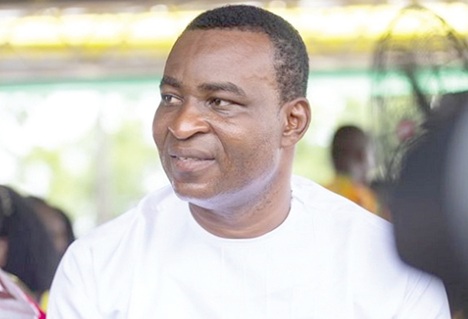
The Accra High Court has adjourned the GH¢30 million Ghana Export-Import Bank (Exim Bank) case involving the convicted former Ashanti Regional Chairman of the New Patriotic Party (NPP), Bernard Antwi-Boasiako, popularly known as Chairman Wontumi, to October 13, 2026.

The adjournment became necessary after the prosecution filed an amended charge sheet in which it amended the charge of uttering a forged document by specifying the company whose pro-forma invoice was allegedly forged.

When the case was called last Tuesday, the Principal State Attorney, Joshua Sackey, told the court that the prosecution had filed a new charge sheet and served copies on counsel for the accused persons.

He, therefore, prayed the court to withdraw the charge sheet filed on May 15, 2026, and substitute it with the new one filed on September 22, 2026.

“My Lady respectfully, we have filed a new charge sheet this morning, and we have given a copy of the charge sheet to counsel for the accused persons,” he said.

“We wish to withdraw the charge sheet, which we filed on May 15, 2026, and substitute the same with the charge sheet, which we filed on September 22, 2026,” he added.

The amended charge sheet, dated September 19, 2026, retains the charge of uttering a forged document under Section 169 of the Criminal Offences Act, 1960 (Act 29).

However, the particulars of the charge now specify that the allegedly forged document was a pro-forma invoice of EPSONS GHANA LIMITED.

The charge sheet alleges that Mr Antwi-Boasiako, in 2017, within the Greater Accra Region, used the forged pro-forma invoice, knowing it was not genuine, with the intent to defraud officials of Exim Bank and obtain GH¢4 million from the bank.

Because of the amendment to the charge, the court is expected to take the pleas of the accused persons afresh when the case resumes on October 13, 2026.

Counsel holding brief for Samuel Atta Akyea for the first and third accused persons, Nana Nti Ofori-Debrah, told the court that he had just received a copy of the new charge sheet and was yet to peruse it and show it to the substantive counsel.

He, therefore, prayed the court to defer the substitution of the charge sheet and the taking of the pleas to the next adjourned date.

“Indeed, I have just received a copy of the new charge sheet.

I am yet to peruse it and also show it to the substantive counsel,” he said.

“In the circumstance, I humbly pray that both the substitution and the taking of plea should be taken at the adjourned date not too remote from now.”

The court subsequently adjourned the case to October 13, 2026, at 10:30 a.m.

Mr Antwi-Boasiako is facing the case together with Thomas Antwi-Boasiako and Wontumi Farms Limited over an alleged GH¢30 million loss to Exim Bank.

The five-count charge sheet includes defrauding by false pretence, two counts of uttering a forged document, money laundering and intentionally causing financial loss to a public body.

The charge sheet alleges that Mr Antwi-Boasiako and Mr Thomas Antwi-Boasiako obtained about GH¢14.302 million from Exim Bank in 2018 by false pretences.

It further alleges that the accused persons caused the bank to lose GH¢30 million between 2018 and 2022.

Connect With Us : 0242202447 | 0551484843 | 0266361755 | 059 199 7513 |

Read at Graphic Online →
Ghana · Regulation

PURC maintains fourth-quarter electricity and water tariffs

PURC maintains fourth-quarter electricity and water tariffs

The Public Utilities Regulatory Commission has approved a zero adjustment to electricity and water tariffs for the fourth quarter of 2026. Existing third-quarter rates will continue from October 1 following the commission’s review of exchange rates, inflation, gas costs and the generation mix. Practitioners advising utilities and commercial consumers should use the commission’s official tariff schedules when reviewing billing and contractual cost adjustments.

The Public Utilities Regulatory Commission (PURC) has maintained electricity and water tariffs at 0 per cent adjustment for the fourth quarter of 2026, with the existing third-quarter rates remaining unchanged.

The unchanged tariffs will take effect from October 1, 2026, following the commission’s quarterly review of utility tariffs to account for developments in key economic and operational factors.

The review considered the Ghana cedi-US dollar exchange rate, inflation, the cost of natural gas and the electricity generation mix, with the cedi depreciating by 3.04 per cent while the weighted average cost of gas declined by 1.67 per cent.

The approval was announced today (September 24) in a statement issued and signed by the Executive Secretary of PURC, Dr Shafic Suleman.

"PURC wishes to inform consumers of electricity and water that: the existing clectricity and water tariffs of the third quarter have not changed, but remain same in the fourth quarter," it said.

The PURC said the average annual inflation rate applied for the fourth quarter was 4.97 per cent, representing an increase of 44.89 per cent from the 3.43 per cent recorded in the previous quarter.

It also applied a weighted average Ghana cedi-US dollar exchange rate of GH¢11.5646 to US 7.8379 per MMBtu, representing a 1.67 per cent decline from US$7.9708 per MMBtu in the third quarter.

It said the projected hydro generation mix was expected to increase from 20.90 per cent to 24.25 per cent, while thermal generation would decline from 79.10 per cent to 75.75 per cent.

The PURC said the combined impact of the hydro-thermal generation mix, exchange rate, inflation and natural gas prices resulted in its decision to maintain electricity tariffs at their existing levels.

It similarly maintained water tariffs at the third-quarter levels for the fourth quarter of 2026.

The commission said the quarterly tariff reviews were intended to account for changes in operational parameters beyond the control of utility service providers while ensuring their financial viability.

It added that it would continue to monitor the operations of regulated service providers and hold them accountable to regulatory standards and benchmarks to ensure value for money and improved quality of service delivery.

The PURC said the quarterly reviews were also intended to maintain the real value of existing tariffs and enable utility providers to remain financially viable.

It said the reviews took into account the impact of tariff levels on the wellbeing of consumers while ensuring that service providers had the resources to deliver reliable services.

The commission said it appreciated stakeholders’ support for the implementation of the quarterly tariff reviews, which helped address changes in operational parameters beyond the control of utility providers.

It further urged regulated service providers to adhere to its regulatory standards and benchmarks to ensure value for money and improved quality of service delivery.

Connect With Us : 0242202447 | 0551484843 | 0266361755 | 059 199 7513 |

Read at Graphic Online →
Ghana · Regulation

GSA reports enforcement against mattress manufacturers

GSA reports enforcement against mattress manufacturers

The Ghana Standards Authority says investigations identified unapproved materials in mattresses and that it has sealed several manufacturing premises with police assistance. The authority raised concerns about chemical emissions, inadequate support and compliance with flammability and safety standards. Manufacturers and distributors should verify applicable standards and enforcement notices, since the report does not identify the precise legal basis or terms of the closures.

Menu Search for Switch skin Home News Politics Business Sports Crime Africa More World Education Editorial Features Lifestyle Technology Gallery Contact Us Facebook X TikTok RSS Switch skin Search for Hot! News Unapproved materials in mattresses pose health risks — GSA September 25, 2026 2 minutes read The Ghana Standards Authority (GSA) has warned consumers against mattresses made with unapproved materials, saying they could pose serious health and safety risks.

According to the authority, some manufacturers were replacing polyurethane foam with materials intended for packaging, potentially exposing users to chemical emissions that could cause respiratory irritation, back and neck pain, poor spinal alignment and other health problems.

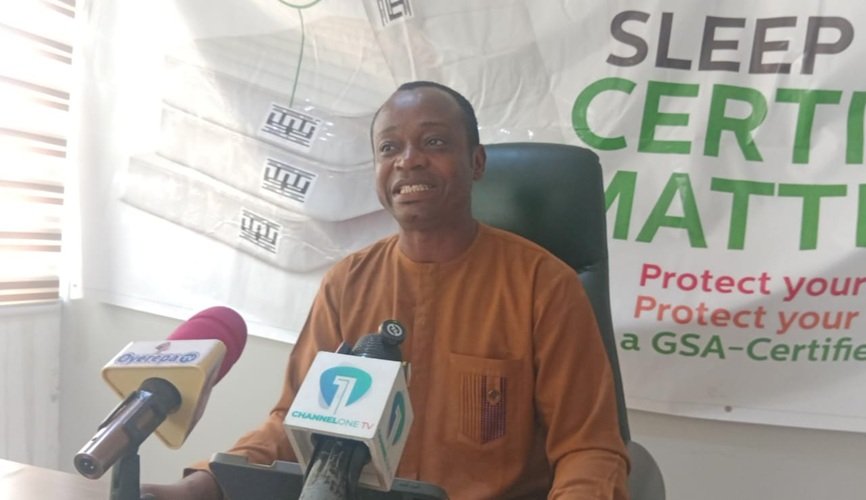
The Chairman of the GSA Technical Committee on Foams and Mattresses, Dr Benjamin Tawia, disclosed this at a press conference in Accra yesterday.

He said investigations by the GSA had uncovered the use of polystyrene and other unapproved polyethylene-based materials in the manufacture of some mattresses.

“Some of these materials are designed for packaging, including protecting appliances, and are not intended for direct human contact or use in bedding,” he said.

Dr Tawia said such materials could expose users to volatile organic compounds and other chemical emissions, while failing to provide the support required for proper spinal alignment.

He further warned that mattresses made with unapproved materials might not meet the required flammability and safety standards, thereby increasing the risk of fire.

As part of efforts to enforce the standards, Dr Tawia said the GSA, together with the Ghana Police Service SWAT team, had sealed a number of mattress manufacturing companies in the Greater Accra Region and parts of Ashaiman during a two-day operation on May 18 and 19, 2026.

The affected companies were Yin Yuan Jia Limited, Mooda/Monda Ghana Mattresses, Hue Sheng Company, Asano Service, ZXZ Company Limited, Rockfoam Mattresses and 5A Home Company.

He said the action formed part of measures to ensure that mattresses manufactured and sold to the public met the required standards.

Dr Tawia urged consumers to be particularly cautious about mattresses that were unusually cheap or had a strong chemical smell, saying those could be warning signs of substandard products.

He advised consumers to ensure that mattresses they purchased were made from 100 per cent polyurethane foam and carried the GSA certification mark, GS 1211:2019.

He also cautioned consumers against unusually low-priced mattresses advertised as “memory foam”, describing such prices as a possible red flag.

“Consumers should buy mattresses from registered or licensed retailers and report suspected fake or unapproved products to the GSA on 0302-500065 or 0302-500066,” he said.

You can now read the *Ghanaian Times* and *The Spectator* newspapers digitally on [TimesNewsPlus]( https://timesnewsplus.com/newspapers ).

Follow our WhatsApp Channel now! https://whatsapp.com/channel/0029VbAjG7g3gvWajUAEX12Q

Read at Ghanaian Times →
Ghana · Procedure

Speaker summons extraordinary parliamentary sitting

Speaker summons extraordinary parliamentary sitting

The Speaker has summoned Parliament for September 29, 2026, at noon, invoking article 112(3) of the Constitution and Parliament’s Standing Orders. The summons follows a Minority petition seeking scrutiny of narcotics seizures, but the notice does not specify the business to be considered. Public law practitioners should distinguish the formal summons from the petitioners’ proposed agenda and await the published parliamentary business.

The Speaker of Parliament, Alban Sumana Kingsford Bagbin, has summoned Parliament to sit on Tuesday, September 29, 2026, amid growing calls for parliamentary scrutiny of recent major narcotics seizures linked to Ghana.

In a notice issued on Thursday, September 24, the Speaker said the sitting would commence at 12 noon at Parliament House in Accra.

“Pursuant to Article 112 (3) of the Constitution and the Standing Orders of Parliament, I, Rt. Hon. Alban Sumana Kingsford Bagbin, hereby summon Parliament to sit on Tuesday, September 29, 2026 at 12 noon at Parliament House, Accra,” the notice stated.

The notice, however, did not specify the particular business to be considered by the House during the extraordinary sitting.

The summons comes days after the Minority in Parliament petitioned the Speaker to recall the House from recess to consider what it described as urgent national security concerns arising from a series of major drug seizures involving consignments linked to Ghana.

Read also: Recall Parliament for extraordinary sitting over cocaine seizures – Habib Iddrisu leads petition

The petition, dated September 18, was submitted on behalf of the Minority Caucus by the First Deputy Minority Whip and Member of Parliament for Tolon, Habib Iddrisu.

The petitioners said they had secured the support of at least 15 per cent of Members of Parliament required under Article 112(3) of the 1992 Constitution to request an extraordinary meeting of the House. The provision requires the Speaker to summon Parliament within seven days after receiving such a request.

At the centre of the petition is the seizure by French customs authorities of nearly 3.9 tonnes of cocaine at the Port of Dunkirk on September 10, 2026.

According to reports cited by the Minority, the cocaine was concealed in a container of plastic waste that had arrived in France from Ghana. French authorities reportedly valued the consignment at about €225 million, or roughly US$260 million.

The Minority argues that the incident raises questions about the security and integrity of Ghana’s ports and export systems, customs controls, intelligence gathering and the effectiveness of narcotics enforcement.

The MPs want Parliament to establish how the container was processed, inspected, cleared and exported from Ghana, including the port or facility from which it departed.

They are also seeking information on the companies and institutions involved in processing and clearing the consignment, the status of investigations and arrests, and the extent of cooperation between Ghanaian authorities and their French and other international counterparts.

The Minority has placed the French seizure in the context of several other narcotics-related incidents since 2025.

Among the cases cited is the reported seizure of more than 3.3 tonnes of cocaine at Pedu Junction in Cape Coast in March 2025.

The caucus has also referred to another consignment of about 120 slabs of cocaine allegedly intercepted along the Takoradi-Cape Coast Highway.

In August 2026, authorities reportedly seized 866 parcels of suspected cocaine concealed in sacks of gari at a warehouse within the Tema Harbour enclave.

The Minority also cited the seizure by Australian authorities of 320 kilogrammes of methamphetamine in June 2026 from a charcoal consignment reportedly traced to Ghana.

The caucus says the incidents collectively warrant an examination of Ghana’s systems for detecting and preventing international narcotics trafficking, including the identification of the financiers, organisers and networks behind major drug-trafficking operations.

The petition calls for officials from the Ministries of the Interior, Transport and National Security, as well as the Narcotics Control Commission (NACOC), Ghana Ports and Harbours Authority (GPHA), Ghana Revenue Authority (GRA), Ghana Immigration Service and National Intelligence Bureau, among other relevant institutions, to provide information to Parliament.

The Minority also wants an assessment of the adequacy of scanning, surveillance, intelligence and security systems at Ghana’s ports, airports and other entry and exit points.

The petitioners have stressed that any parliamentary inquiry should not prejudice ongoing criminal investigations or the rights of persons under investigation.

The demand for parliamentary scrutiny has also received support from some civil society and academic voices.

Dr Joshua Ebuntie Zaato, a Senior Lecturer at the University of Ghana’s Department of Political Science, has argued that Parliament’s oversight role could provide an additional avenue for examining information surrounding the seizures and the response of the various security agencies.

However, there has also been a different view within Parliament on whether an extraordinary sitting is necessary.

The Vice Chairman of Parliament’s Defence and Interior Committee and Wa West MP, Peter Lanchene Toobu, has argued that the relevant parliamentary committees could investigate the matter while the House remains on recess. He cited the Defence and Interior, Transport, and Trade and Industry committees as having oversight responsibilities relevant to the issues raised.

With the Speaker now summoning the House for September 29, attention will turn to the business that will be placed before Parliament and whether the extraordinary sitting will lead to a formal parliamentary inquiry into the recent narcotics-related incidents.

The sitting will also provide an opportunity for Parliament to seek clarification from the relevant institutions on the circumstances surrounding the Ghana-linked consignments and the measures being taken to strengthen the country’s border, port and narcotics-control systems.

Connect With Us : 0242202447 | 0551484843 | 0266361755 | 059 199 7513 |
Read at Graphic Online →
Ghana · Legislation

Women’s rights groups propose stronger constitutional guarantees

Women’s rights groups propose stronger constitutional guarantees

NETRIGHT and the Affirmative Action Law Coalition have issued a position paper challenging aspects of the government’s response to constitutional review recommendations. Their proposals include extending proportional representation across existing parliamentary seats and entrenching a minimum 30 per cent quota for women in Parliament and district assemblies. These remain reform proposals rather than enacted rules, but warrant attention from practitioners working on electoral design, equality and constitutional amendment.

The Network for Women’s Rights (NETRIGHT) and the Affirmative Action Law Coalition (AALC) have issued a consolidated position paper pushing back against some of the government decisions on the Constitutional Review Committee (CRC) report, insisting that key provisions on land rights, natural resources, and gender equality be strengthened before any constitutional amendments take effect.

The two groups’ response comes after the government accepted, rejected or modified various CRC recommendations across 14 priority areas, with the two arguing that many of the “not accepted” positions leave women and persons with disabilities exposed to continued discrimination.

At a meeting organised by NETRIGHT with the AALC, they called on the government to immediately extend proportional representation to all 276 existing parliamentary seats, rather than confining it to an additional 24 seats as currently proposed, while also entrenching a minimum 30 per cent quota for women in both Parliament and district assemblies.

In its position paper, while welcoming the government’s acceptance of proportional representation in principle, the AALC argued the proposal falls short of a genuine proportional system, since it would leave the bulk of Parliament under the existing constituency-based structure.

The government had proposed expanding Parliament to 300 members, made up of 276 directly elected constituency seats and 24 additional seats to be filled through proportional representation among women, persons with disabilities (PwDs) and the youth.

The coalition warned that the government’s 24-seat proposal would not guarantee meaningful gains for women, since the seats were shared among three categories.

It calculated that if divided equally, women would gain only eight seats, representing roughly 2.7 per cent of an expanded 300-member House — far short of the 90 seats needed to meet a 30 per cent threshold.

The coalition cited historical data showing women’s representation had never exceeded 20 per cent since independence, standing at just 9.6 per cent in 1960 and currently at about 14.86 per cent, with 41 women among the 276 MPs elected in 2024.

At the local level, the AALC described the situation as more severe, noting that women’s representation in District Assemblies had stayed below 10 per cent in every election since 1994, falling to about 4.1 per cent in 2023, when only 269 of nearly 6,300 elected members were women despite 1,049 women contesting seats.

The coalition renewed its proposal for a new constitutional provision, Article 242(e), guaranteeing that at least 30 per cent of District Assembly Members be women, alongside a parallel amendment to Article 93 to secure the same threshold in Parliament.

It urged that the one-third appointed component of District Assemblies be used immediately to boost women’s numbers ahead of the 2027 District Assembly elections.

On government’s proposal to have District Chief Executives (DCEs) elected, with at least two of five presidential nominees required to be women, the AALC cautioned that nomination and shortlisting did not amount to actual representation, and called for mechanisms to monitor real outcomes for women in DCE elections.

The coalition concluded that Ghana’s constitutional review offered a rare chance to move women’s political equality from an aspiration to an enforceable guarantee, insisting that proportional representation, constitutional quotas and the Affirmative Action (Gender Equity) Act, 2024, must work together rather than in isolation to close a representation gap that has persisted since independence.

NETRIGHT in its position paper also proposed reforms to Article 22 to ensure equitable distribution of marital property, arguing that courts’ longstanding “substantial contribution” test has disadvantaged women whose contributions often take the form of unpaid domestic labour.

NETRIGHT’s submission concludes with a broader structural demand: that disability inclusion and gender-responsive governance be treated as cross-cutting constitutional principles binding on all branches and levels of government, rather than confined to a single chapter of the CRC report.

It said this would ensure gender and disability considerations were embedded in budgeting, planning and resource governance decisions nationwide, rather than left to piecemeal legislation.

Writer’s email: This email address is being protected from spambots. You need JavaScript enabled to view it.

Connect With Us : 0242202447 | 0551484843 | 0266361755 | 059 199 7513 |

Read at Graphic Online →
Ghana · Profession

Counsel alleges attempted detention outside High Court

Counsel alleges attempted detention outside High Court

Nana Agyei Baffour Awuah, MP and counsel in the Ghana Jollof proceedings, alleges that a person claiming to be an EOCO official attempted to take him into custody after a court appearance without producing identification. His account raises questions about the identification of enforcement officers and the legal basis communicated for a demand to accompany them. The supplied report contains no EOCO response or judicial finding, so the incident should be treated as an allegation requiring clarification, not an established unlawful arrest.

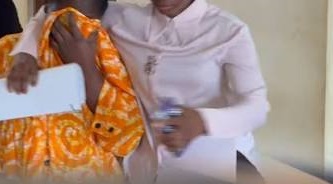
The Member of Parliament for Manhyia South, Nana Agyei Baffour Awuah, has accused an Economic and Organised Crime Office (EOCO) official of attempting to take him into custody without properly identifying herself after he appeared at the Accra High Court on Wednesday, September 23, 2026.

The MP said the incident happened shortly after he represented Salomey Awitty Baffoe in court. According to him, a woman approached him after the proceedings, identified herself as an EOCO official and informed him that he was required at the agency’s office.

Baffour Awuah said he requested identification and sought clarification about why he was being asked to report to EOCO, but the woman allegedly failed to produce an identification card or other evidence to establish her authority.

He said he subsequently offered to drive himself to the EOCO office, but the official allegedly insisted on taking him with her. According to the lawmaker, she then held his hand as he attempted to leave, leading to a confrontation near his Toyota Land Cruiser.

The MP said the official later stood in the way of his vehicle, but eventually moved aside, allowing him to drive away. He questioned why he should have complied with the request when, in his account, the person had not demonstrated that she was acting on behalf of EOCO.

Speaking on Citi FM on Thursday, September 24, Nana Agyei Baffour Awuah described the encounter as a deliberate attempt to provoke him, saying he managed to remain composed despite the confrontation.

“Clearly, she was there to provoke me because at that point, you don’t have an ID card that shows you are from EOCO,” he said. “You are there to also aggressively take me. It was a clear act of provocation, which, with the greatest of respect and the help of God, I was able to withstand.”

The incident occurred after court proceedings involving Salomey Awitty Baffoe, who has been linked by prosecutors to the operator of the Ghana Jollof TikTok account.

Read at MyJoyOnline →