§ Briefing, Sunday, 27 September 2026

EOCO powers questioned as petroleum legislation approaches

EOCO’s attempted arrest of a lawyer-MP raises questions about investigative powers and professional fees. Petroleum bills, a pending narcotics bail ruling and proposed pay reforms also warrant attention.

Ghana · Procedure

EOCO invitation powers and attempted arrest disputed

EOCO invitation powers and attempted arrest disputed

Ghana School of Law lecturer Lenin Nicholas Anane Agyei has challenged the legal basis of EOCO’s attempted arrest of Nana Agyei Baffour Awuah. He argues that section 19 of the Economic and Organised Crime Office Act, 2010 (Act 804) penalises failure to produce required documents but does not criminalise failure to honour an invitation. This is a commentator’s interpretation, not a judicial determination of the arrest’s legality. Practitioners should distinguish the statutory consequences of non-attendance from any separate lawful grounds for arrest.

Lawyer and lecturer at the Ghana School of Law, Lenin Nicholas Anane Agyei, has argued that the attempted arrest of Manhyia South MP Nana Agyei Baffour Awuah by the Economic and Organised Crime Office (EOCO) had no sufficient legal basis.

Speaking on JoyNews’ Newsfile on Saturday, Mr Anane Agyei described the attempted arrest as “flawed beyond saving”, arguing that Section 19 of the Economic and Organised Crime Office Act, 2010 (Act 804) does not criminalise a person’s refusal to honour an invitation from EOCO.

“Plainly speaking, the attempted arrest of Honourable Baffour Awuah was flawed beyond saving,” he said.

He explained that Section 19(1) gives the EOCO Executive Director the power to invite a person to assist with an investigation and also empowers the office to compel the furnishing or production of documents.

However, he pointed to Section 19(5), which he said expressly criminalises failure to produce documents when required, but does not provide a similar criminal consequence for refusing to appear in response to an invitation.

“When you go to Section 19(5), it criminalises failure to produce documents when it is required, but it has not said anything about a refusal to honour an invitation,” he said.

Mr Anane Agyei therefore rejected the suggestion that the absence of a specific sanction for refusing an invitation amounted to an unintended gap in the law.

“And so it was not a lacuna intended by Parliament. Parliament intended not to criminalise refusal to appear, because an invitation is what it is,” he said.

According to him, had Parliament intended EOCO to have the power to impose criminal consequences on a person who declined an invitation to appear, it would have expressly provided for such consequences in the legislation.

“If Parliament intended that EOCO requires you to appear and you refuse to, you should have consequences, it would have in that same section being provided,” he said.

On that basis, he argued that even if Mr Baffour Awuah had failed to respond to or attend an EOCO invitation, that failure alone could not have provided the legal basis for his arrest.

“So on that score, the failure of Baffour Awuah to respond or attend the invitation, even if he so did, will not have been the basis for EOCO to arrest him in any sort of manner,” he said.

He further questioned the legality of the attempted arrest in the absence of an arrest warrant, arguing that the circumstances did not satisfy the requirements for a warrantless arrest.

“The fact that there was the absence of warrant and also, the fact that the conditions for a warrantless arrest did not exist,” he said.

Mr Anane Agyei acknowledged that warrantless arrests occur frequently in Ghana but stressed that their occurrence does not, in itself, establish their legality.

“I dare say that most of the arrest that happens in this country often are warrantless,” he said.

His comments follow the confrontation between the Manhyia South MP and EOCO personnel at the Accra High Court on Wednesday, September 23.

Read at MyJoyOnline →
Ghana · Profession

Professional fees become an issue in EOCO dispute

Professional fees become an issue in EOCO dispute

Nana Agyei Baffour Awuah has questioned whether EOCO has authority to regulate lawyers’ professional fees, following allegations that he charged unapproved fees. He denies the reported payments to himself or SBA and Partners and rejects allegations concerning a judicial sale and related transfers. The report establishes neither misconduct nor a ruling on EOCO’s jurisdiction. For practitioners, the relevant distinction is between professional fee regulation and investigation of allegedly unlawful transactions involving legal fees.

Member of Parliament for Manyhia South, Nana Agyei Baffour Awuah, has questioned whether the Economic and Organised Crime Office (EOCO) is responsible for regulating or determining lawyers’ professional fees.

In a Facebook post on Saturday, September 26, the MP said the latest allegation against him followed an earlier claim that he had refused to honour an invitation from EOCO.

“First, they said I refused to honour their invitation. When that propaganda failed, they now claim that I charged unapproved professional fees,” Nana Agyei Baffour Awuah wrote.

He then questioned the basis of the latest claim, asking: “But the question is: Is EOCO responsible for regulating or determining lawyers’ professional fees?”

His comments come after he denied allegations that GHS2.2 million out of a GHS5 million amount was paid to him or his law firm, SBA and Partners, as legal fees.

The MP also denied claims that he or SBA and Partners transferred money to the then Managing Director of SIC Life Savings and Loans.

He further rejected allegations of a judicial sale of a property for GHS24 million, maintaining that no such judicial sale took place and, consequently, there could have been no remittance of GHS6 million from an alleged buyer to himself or his firm.

Read at MyJoyOnline →
Ghana · Legislation

Energy committee signals petroleum bills and currency review

Energy committee signals petroleum bills and currency review

The Parliamentary Select Committee on Energy intends to examine the requirement that domestic refineries pay for Ghanaian crude in US dollars when Parliament resumes in October. Its chairman says a National Petroleum Authority Bill and a Petroleum Revenue Management Bill are expected before Parliament. The announcement indicates a legislative agenda, not an enacted change to payment obligations. Energy counsel should monitor the published texts for implications for crude-supply contracts, currency risk and petroleum revenue arrangements.

The Parliamentary Select Committee on Energy has said it will scrutinise the policy requiring local oil refineries to pay in US dollars for Ghana’s crude oil, amid concerns that the arrangement is imposing additional foreign exchange pressure on domestic refining.

The committee is expected to engage the National Petroleum Authority (NPA) and other stakeholders when Parliament resumes in October this year, to examine whether the current payment arrangement was appropriate for a local refining industry that sells petroleum products largely in cedis or not.

The Chairman of the committee, Emmanuel Kwasi Bedzrah, announced this last Tuesday when the committee inspected the Sentuo Oil Refinery in Tema as part of its parliamentary oversight activities.

“I can tell you on authority that when we return to Parliament in October, there are two bills that will be coming before us — the National Petroleum Authority Bill and the Petroleum Revenue Management Bill.

“We will be looking at them, particularly this issue of how a local product that is sold on the local market is treated.

I can assure you that when we resume in October, we will look at the matter and consider what needs to be done,” he said.

The proposed scrutiny places the foreign currency requirement at the centre of a wider policy debate over how the nation can retain more value from its crude resources, while building a sustainable domestic refining industry.

It follows concerns raised by management of Sentuo Oil Refinery that having to source US dollars to purchase locally produced crude creates an additional foreign exchange burden, although the refinery processes the crude locally and sells its refined products on the domestic market.

Mr Bedzrah said the committee would consider the position of the NPA alongside concerns from refinery operators before determining what parliamentary action might be required.

The issue has already received presidential attention. In August this year, President John Dramani Mahama directed the Minister of Energy and Green Transition, Dr John Abdulai Jinapor, to reconsider the existing arrangement and explore the possibility of allowing the Tema Oil Refinery (TOR) and Sentuo to pay for the nation’s indigenous crude in cedis.

Mr Bedzrah said strengthening domestic refining capacity was essential to reducing the nation’s dependence on imported petroleum products and retaining more economic value from the country’s crude.

The Ranking Member of the committee, George Kwame Aboagye, said the government and local refineries needed to work together to remove policy and operational constraints threatening the sustainability of domestic refining.

He said sector policies should support efficient refinery operations and competitiveness, while avoiding unnecessary costs that could ultimately affect consumers.

The Executive Chairman and President of Sentuo Group, Xu Ningquan, also urged the committee to help in reviewing the dollar-payment arrangement to reduce foreign exchange pressure and improve the operating environment for local refineries.

The International Business and Coordination Director of Sentuo Group, Mr Samson Deen, also called for closer government-industry collaboration to address foreign exchange and crude supply challenges to enable local refineries to compete more effectively.

Connect With Us : 0242202447 | 0551484843 | 0266361755 | 059 199 7513 |

Read at Graphic Online →
Ghana · Procedure

Bail ruling scheduled in cocaine export prosecution

Bail ruling scheduled in cocaine export prosecution

The Kwabenya Circuit Court has set 29 September for a ruling on bail applications by six accused persons in proceedings connected with the seizure of 3.9 tonnes of cocaine in France. Counsel renewed the applications after bail had been refused at the previous adjournment. The pending ruling is the material procedural development; the accompanying calls for further arrests are political and professional commentary. Practitioners should await the court’s reasons before drawing conclusions about the applicable bail considerations.

Search Watch live Home News Politics Business Sports Entertainment Opinion Videos More Cocaine: Arresting the couriers alone will not solve the problem - Kwarteng The Kwabenya Circuit Court set September 29 for ruling on bail applications for six persons standing trial for their connection with the seizure of 3.9 tonnes of cocaine in France

Copy link Add 3News as your preferred source on Google Preferred source Article tools Ask AI Listen to this article AI narration Playback position 0:00 3:29 10 10 Playback speed 1× Kwasi Kwarteng, Private Legal Practitioner and a member of the New Patriotic Party (NPP), has called on the security agencies to arrest the kingpins behind the drug trade in Ghana.

He makes the point that arresting the couriers alone will not solve the drug menace in Ghana.

"The couriers have been picked up, but we have not had sufficient updates on the alleged key suspects.

"Arresting the couriers will not solve the problem if the financiers and kingpins remain untouched," he said on the Key Points on TV3 Saturday, September 26.

His coments come at a time when the Kwabenya Circuit Court set September 29 for ruling on bail applications for six persons standing trial for their connection with the seizure of 3.9 tonnes of cocaine in France.

Earlier, counsel for the accused persons prayed the court for bail having been denied by the court at the last adjourned date.

Francis Narh Amanor, owner of the logistics company that handled the export of the consignment in which the cocaine was allegedly concealed; Frank Adu Boahen, the alleged owner of the goods; Togbe Agbeti; Andrews Tetteh Amponsah; Daniel Laryea; and Helena Akua Dekyi, all of whom are linked to the Ghana Revenue Authority (GRA) Customs Division have been charged with conspiracy to export narcotic drugs and unlawful exportation of narcotic drugs.

In court on Thursday, September 24, the six accused persons, represented by separate legal teams, prayed the court to grant them bail with the counsel arguing that their clients have been cooperative with the investigators and the court.

They also noted that the accused persons had demonstrated beyond reasonable doubt their willingness to stand trial.

After listening to the arguments, the presiding judge adjourned proceedings to Tuesday, September 29, for ruling on the bail application.

Per the prosecution's facts of the case, Frank Adu-Boahen shared his login credentials to other accused persons and relegated his duty to scan the containers.

Despite detecting anomalies after the scan, the prosecution added that the containers were allegedly given the greenlight without being subjected to further examination before being released.

The prosecution also alleges that after arresting Adu-Boaten at his hideout at Community 19, Tema, on September 16, he admitted during interrogation to owning the four 40-foot containers and loading them at a warehouse at Community 12, Tema.

Together with the first accused, Francis Narh Amanor, Frank also told investigators that they shipped the containers.

According to the facts of the case, prosecution further alleged that Francis Narh Amanor, the Managing Director of Fresna Commodities Ltd, was arrested on September 15.

Investigations further disclosed that the ICUMS system identified Fresna Commodities Ltd as the exporter, with first accused's phone number listed as the exporter’s contact.

The prosecution also indicated that the same number was reportedly associated with F&F Logistics, identified as the freight forwarder in the export of the containers.

The prosecution alleges that the first and second accused exported the four containers from Tema Port containing approximately 3.9 tonnes of suspected narcotic substances.

#5 Presidential Drive, Adesa We, Kanda, Greater Accra. Ghana

Read at 3News →
Ghana · Regulation

Talensi council announces mining consent resolution

Talensi council announces mining consent resolution

The Talensi Traditional Council has announced a resolution requiring its prior written consent and relevant mineral and environmental authorisations for mining within the traditional area. It says breaches will attract referral to law enforcement and customary sanctions. The report does not establish the legal scope or enforceability of the additional consent requirement or sanctions. Mining practitioners should examine the resolution against statutory licensing powers, land-access rights and the limits of customary authority.

Search Watch live Home News Politics Business Sports Entertainment Opinion Videos More Talensi Traditional Council bans unauthorised mining in the area The Council stated that any person who violates the resolution will be reported to law enforcement agencies for prosecution and will be liable to customary sanctions as determined by the Traditional Council.

Copy link Add 3News as your preferred source on Google Preferred source Article tools Ask AI Listen to this article AI narration Playback position 0:00 2:14 10 10 Playback speed 1× The Talensi Traditional Council, pursuant to its customary mandate and the laws of Ghana, has banned all mining activities within the Talensi Traditional Area without the prior written consent of the Council and a valid licence from the Minerals Commission and the Environmental Protection Authority (EPA).

The Council stated that any person who violates the resolution will be reported to law enforcement agencies for prosecution and will be liable to customary sanctions as determined by the Traditional Council.

On responsible mining, the Council said: "The Council supports responsible, legal and environmentally sustainable mining that creates jobs for the youth of Talensi and contributes to the development of the Traditional Area."

According to the Council, the resolution follows the alarming increase in unauthorized mining activities and their effects on Talensi lands. It noted that water bodies, sacred groves and natural resources are at risk due to illegal mining without proper supervision.

The Council expressed concern that unauthorized mining groups, popularly known as galamsey, have encroached on farmlands, sacred sites, water bodies and community lands without the consent of the Traditional Council.

It added that unauthorized mining is causing severe environmental degradation, pollution of water sources, destruction of economic trees and threats to public health and safety.

Additionally, the Council stated that these unauthorized groups disregard customary procedures, bypass the authority of chiefs and Tindanas, and are causing conflicts and insecurity in the Traditional Area.

The Council further resolved to enforce compulsory customary consent, protect sacred and protected areas, collaborate with state agencies, and set up a community monitoring committee.

The resolution, signed by the President of the Traditional Council, Tongraan Kugbilsong Nalegbegtang, along with divisional chiefs, Tindanas and queen mothers from the three zones of the Traditional Area, called on all citizens, residents and investors to respect the directive in the interest of peace, security and sustainable development of Talensi.

#5 Presidential Drive, Adesa We, Kanda, Greater Accra. Ghana

Read at 3News →
Ghana · Regulation

Public emoluments transition raises collective agreement questions

Public emoluments transition raises collective agreement questions

The Fair Wages and Salaries Commission has consulted state-owned enterprise leaders on the proposed transition to an Independent Public Emoluments Commission. Participants sought clarity on existing collective agreements, board autonomy and the treatment of market premiums and allowances. The commission’s chief executive said performance incentives would be harmonised under a new National Emoluments Policy and National Negotiation Framework. These assurances do not themselves amend employment obligations, making the eventual legal framework and transitional provisions important for employment and public-sector counsel.

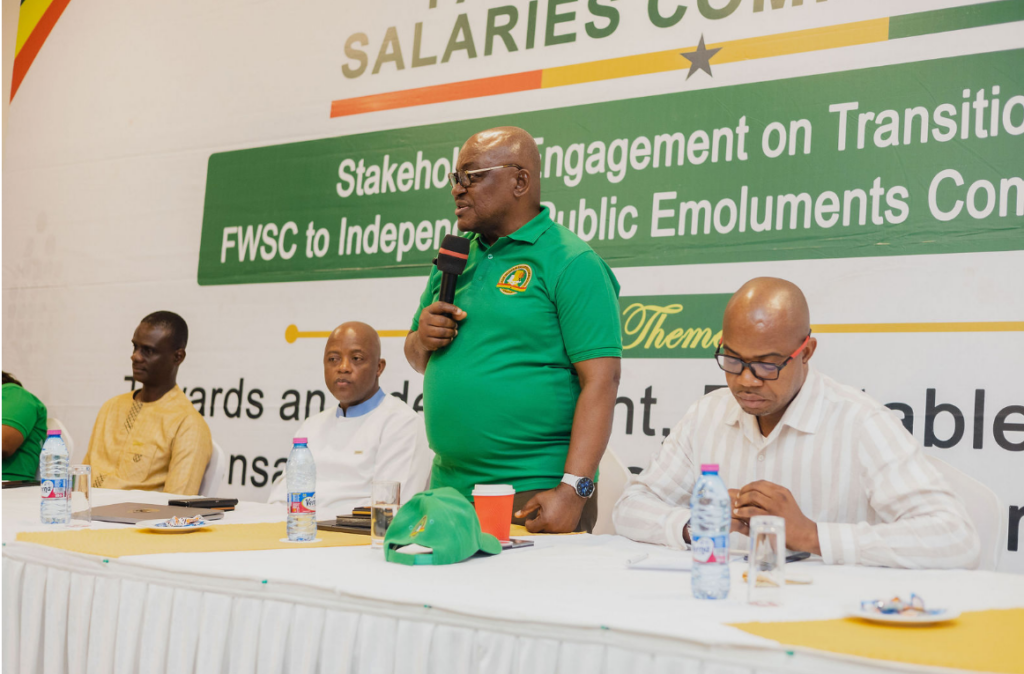
The Fair Wages and Salaries Commission (FWSC) on Friday engaged chief executive officers of State-Owned Enterprises (SOEs) on the transition to the Independent Public Emoluments Commission (IPEC).

The stakeholder meeting brought together CEOs, Deputy CEOs, Finance and Human Resource Directors of more than 100 SOEs, as well as representatives of the State Interests and Governance Authority (SIGA), Development Partners and the media.

It is part of a series of nationwide consultations being undertaken by the FWSC following President John Dramani Mahama's declaration of the Commission as an Institution in Transition in March this year.

Addressing the participants, the Chief Executive of the FWSC, Dr George Smith-Graham, said SOEs account for a significant portion of the public sector wage bill and are central to the ongoing pay reforms.

He described Ghana's current public sector remuneration system as fragmented, inequitable and a major source of industrial relations tensions, especially within the SOE sector.

"The new IPEC will provide an independent, professional and evidence-based framework for determining all public sector emoluments, including SOEs, while ensuring fiscal sustainability, transparency and equity," Dr Smith-Graham assured.

During an open forum, some of the attendees expressed concern about how the new regime will affect their ability to attract and retain critical talent, the fate of existing Collective Agreements, and the level of autonomy Boards will retain to determine market premiums and allowances.

Responding to the concerns, Dr. Smith-Graham explained that IPEC will not scrap performance-based incentives, but will rather streamline and harmonize them under a new National Emoluments Policy and a National Negotiation Framework.

He disclosed that as part of the reform, Government will undertake a comprehensive nationwide Job Evaluation exercise to establish a modern grading architecture and ensure equal pay for work of equal value. A National Productivity Framework will also be developed to link remuneration to productivity and performance.

The FWSC indicated that inputs from the engagement will feed into the final draft IPEC Bill, which is expected to be laid before Parliament before the end of October 2026.

Read at MyJoyOnline →
Ghana · Legislation

Reserved parliamentary seats proposal raises constitutional design issues

Reserved parliamentary seats proposal raises constitutional design issues

A published opinion article describes a government proposal to cap Parliament at 300 members, retaining 276 constituency seats and adding 24 proportional-representation seats for women, persons with disabilities and young people. The supplied report contains no amendment text or evidence of enactment. The proposal raises questions about eligibility, allocation methods and its relationship with the Affirmative Action (Gender Equity) Act, 2024 (Act 1121). Constitutional practitioners should treat the account as reform commentary pending authoritative proposals and clarification of the amendment process.

Ghana's constitutional reform process has moved from consultation to implementation.

Among the proposals attracting the most attention is the government's plan to cap Parliament at 300 members.

The existing 276 constituency seats would remain, with 24 additional seats allocated through proportional representation for women, persons with disabilities and young people.

This is potentially an important step. But the real question is no longer whether proportional representation should be introduced but how it will be designed.

Ghana runs a first-past-the-post electoral system, and that fact matters more than it might first appear.

In a first-past-the-post system, each constituency produces a single winner, and party gatekeeping, incumbency and the cost of competition tend to reproduce whoever already holds power.

Affirmative action measures such as party quotas, financial concessions, and encouragement to run can shift outcomes only gradually within that architecture, because they still depend on parties choosing to nominate and support women in winnable seats. Ghana's experience under the Affirmative Action (Gender Equity) Act, 2024 (Act 1121) illustrates the importance of moving from commitments on paper to mechanisms that produce measurable representation.

This is precisely why the government's proposal deserves credit. Under a first-past-the-post system, reserved seats allocated outside constituency competition are one of the few mechanisms that can guarantee rather than merely encourage representation. Affirmative action reshapes incentives, whereas reserved seats directly guarantee outcomes.

Countries that use proportional list systems can build gender balance into the list itself. Ghana, working within a predominantly constituency-based system, does not have that option available to it in the same way, which is exactly why a dedicated PR component for the 24 seats matters.

Ghana needs both affirmative action and reserved seats, but they are not substitutes for one another, and the White Paper is right to treat the 24 seats as a distinct lever rather than folding the problem back into affirmative action alone.

That said, a mechanism designed to guarantee representation only works if its internal rules do so as well.

If women, persons with disabilities and young people are simply placed within one pool of 24 seats without clear allocation rules, women's representation could remain uncertain.

Groups that have historically been excluded from political power should not be placed in competition with one another, with the representation of any one group left dependent on political bargaining among the rest.

The implementation framework must, therefore, contain clear, enforceable gender guarantees not as a special favour, but because women make up roughly half (50.7 per cent) of Ghana's population, and their representation in Parliament is a matter of democratic legitimacy, not interest-group accommodation.

The design should also reinforce Act 1121 rather than operate alongside it as a separate initiative.

If party lists are ultimately part of the model, the rules governing those lists will be decisive.

Gender-balanced or alternating lists can prevent women from being placed in positions where they are unlikely to obtain seats; transparent nomination and allocation procedures will be equally important.

The process must also account for the fact that women are not a homogeneous group.

Young women, women with disabilities and women from marginalised communities can face overlapping barriers that a single, undifferentiated quota may not address.

The independent study the government has proposed should not be treated as a technical exercise conducted behind closed doors.

It should examine the likely gender impact of different models, the relationship to Act 1121, and the implications for regional representation and electoral integrity with meaningful input from women's rights organisations, women political leaders and aspirants, persons with disabilities, political parties, electoral experts and civil society.

Representation must also be meaningful, not merely numerical. Members entering Parliament through proportional representation must carry the same constitutional status, legislative opportunities and institutional support as constituency MPs.

The goal is not a second tier of legislators, but a Parliament that better reflects the country it serves.

Public education will also matter; therefore, constitutional reform cannot succeed if citizens do not understand what is being proposed.

Before any referendum, Ghanaians should have clear, evidence-based information about how the 24 seats will work, who can participate, and what the reform means for democratic representation.

GenCED supports the direction but calls for enforceable gender guarantees, transparent allocation rules and meaningful public participation in the design process.

Ghana has an opportunity to move beyond asking whether women are participating in politics, and to ask instead whether our institutions are designed to make that participation possible.

Proportional representation, deliberately and transparently designed, can be that instrument.

But under a first-past-the-post system, the design is not a technical afterthought, but it is the substance of the reform.

The writer is Executive Director, Gender Centre for Empowering Development (GenCED)

Connect With Us : 0242202447 | 0551484843 | 0266361755 | 059 199 7513 |

Read at Graphic Online →
Ghana · Procedure

Payment of court fines reportedly secures prisoner releases

Payment of court fines reportedly secures prisoner releases

Power of Worship International reportedly paid outstanding court fines to secure the release of 23 inmates from Nsawam Medium Security Prison. The account highlights the access-to-justice consequences of inability to pay fines and the importance of checking the basis for continued custody. It does not provide the sentencing orders, amounts paid or release documentation, and separately refers to transport support for 20 people. Counsel assisting prisoners should verify individual default terms, payment records and release status rather than rely on the aggregate account.

The Power of Worship International (POWI), led by Head Pastor Prophet Daniel Amoateng, has helped with the payment of outstanding court fines for 23 inmates from the Nsawam Medium Security Prison.

For many of the minor offenders, their inability to pay court-imposed fines led to prolonged incarceration.

Recognising the systemic challenge, which was a contributory factor to congestion in the prison, Prophet Daniel Amoateng and POWI stepped in to offer help for their societal reintegration.

Beyond settling the financial obligations required for their immediate release, the church extended its support to ensure a seamless transition back into society. The beneficiaries were treated to a special dinner hosted by the ministry, providing a warm atmosphere of fellowship, dignity, and encouragement before returning to their communities.

POWI covered the transportation costs for all 20 individuals to reach their respective destinations safely and has also offered to provide each released inmate with financial seed capital to start life afresh, empowering them to establish small enterprises or secure livelihoods without resorting to circumstances that led to their initial imprisonment.

Speaking on the initiative, Prophet Amoateng emphasized that the gesture aligns with the core mandate of the Gospel: extending love, mercy, and tangible support to the vulnerable and disenfranchised.

By addressing both the spiritual and socio-economic needs of the beneficiaries, POWI continues to set an inspiring benchmark for religious organizations playing active roles in social reform.

Connect With Us : 0242202447 | 0551484843 | 0266361755 | 059 199 7513 |

Read at Graphic Online →