Energy Committee signals petroleum bills and crude payment review
The Parliamentary Select Committee on Energy intends to examine the requirement for domestic refineries to pay for Ghanaian crude in US dollars when Parliament resumes in October. Its chairman said a National Petroleum Authority Bill and a Petroleum Revenue Management Bill were expected before Parliament. Counsel advising refiners and petroleum-sector counterparties should monitor the texts for changes affecting payment obligations and sector regulation. The report establishes neither that the bills have been introduced nor that the existing payment arrangement has changed.
The Parliamentary Select Committee on Energy has said it will scrutinise the policy requiring local oil refineries to pay in US dollars for Ghana’s crude oil, amid concerns that the arrangement is imposing additional foreign exchange pressure on domestic refining.
The committee is expected to engage the National Petroleum Authority (NPA) and other stakeholders when Parliament resumes in October this year, to examine whether the current payment arrangement was appropriate for a local refining industry that sells petroleum products largely in cedis or not.
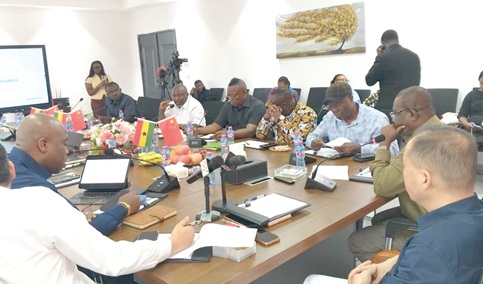
The Chairman of the committee, Emmanuel Kwasi Bedzrah, announced this last Tuesday when the committee inspected the Sentuo Oil Refinery in Tema as part of its parliamentary oversight activities.
“I can tell you on authority that when we return to Parliament in October, there are two bills that will be coming before us — the National Petroleum Authority Bill and the Petroleum Revenue Management Bill.
“We will be looking at them, particularly this issue of how a local product that is sold on the local market is treated.
I can assure you that when we resume in October, we will look at the matter and consider what needs to be done,” he said.
The proposed scrutiny places the foreign currency requirement at the centre of a wider policy debate over how the nation can retain more value from its crude resources, while building a sustainable domestic refining industry.
It follows concerns raised by management of Sentuo Oil Refinery that having to source US dollars to purchase locally produced crude creates an additional foreign exchange burden, although the refinery processes the crude locally and sells its refined products on the domestic market.
Mr Bedzrah said the committee would consider the position of the NPA alongside concerns from refinery operators before determining what parliamentary action might be required.
The issue has already received presidential attention. In August this year, President John Dramani Mahama directed the Minister of Energy and Green Transition, Dr John Abdulai Jinapor, to reconsider the existing arrangement and explore the possibility of allowing the Tema Oil Refinery (TOR) and Sentuo to pay for the nation’s indigenous crude in cedis.
Mr Bedzrah said strengthening domestic refining capacity was essential to reducing the nation’s dependence on imported petroleum products and retaining more economic value from the country’s crude.
The Ranking Member of the committee, George Kwame Aboagye, said the government and local refineries needed to work together to remove policy and operational constraints threatening the sustainability of domestic refining.
He said sector policies should support efficient refinery operations and competitiveness, while avoiding unnecessary costs that could ultimately affect consumers.
The Executive Chairman and President of Sentuo Group, Xu Ningquan, also urged the committee to help in reviewing the dollar-payment arrangement to reduce foreign exchange pressure and improve the operating environment for local refineries.
The International Business and Coordination Director of Sentuo Group, Mr Samson Deen, also called for closer government-industry collaboration to address foreign exchange and crude supply challenges to enable local refineries to compete more effectively.
Connect With Us : 0242202447 | 0551484843 | 0266361755 | 059 199 7513 |