§ Briefing, Tuesday, 29 September 2026

Gold purchasing rules change; offshore licences face scrutiny

GoldBod’s revised purity-testing requirements take effect on 1 October. Other developments concern offshore reconnaissance licences, voluntary school purchases, nurses’ employment protections and national service compliance.

Ghana · Regulation

GoldBod revises testing requirements for local gold purchases

GoldBod revises testing requirements for local gold purchases

GoldBod has announced that, from 1 October 2026, X-Ray Fluorescence testing will determine gold doré purity and payment for purchases by the Board and its licensed buyers. Water Density testing will become indicative only, subject to specified exceptions permitting purchases at a 0.7 percent purity discount where XRF is operationally unavailable or both parties voluntarily agree. Successive XRF results must fall within the stated tolerance of plus or minus 0.1 percent, with larger differences verified before completion or reporting, requiring practitioners to review clients’ testing, pricing and transaction procedures against the compliance notice.

Menu Search for Switch skin Home News Politics Business Sports Crime Africa More World Education Editorial Features Lifestyle Technology Gallery Contact Us Facebook X TikTok RSS Switch skin Search for Hot! News GoldBod changes gold testing rules for local purchases from October 1 September 28, 2026 1 minute read The Ghana Gold Board (GoldBod) has announced changes to how the purity of gold will be tested for local purchases, with the new rules taking effect from October 1, 2026.

The notice was issued today by the Compliance Directorate of the Ghana Gold Board.

Under the new arrangement, the Water Density method will only be used to give an indication of the purity of gold and will no longer serve as the final basis for determining its purity, price or payment.

In a compliance notice issued on September 28, GoldBod said X-Ray Fluorescence (XRF) testing would become the definitive method for determining the purity of gold doré purchased by the Board and its licensed buyers.

It explained that the applicable payment for gold would therefore be based on the purity determined through the XRF method.

However, GoldBod said where a licensed buyer is unable to use XRF due to genuine operational or logistical challenges, or where both the buyer and seller voluntarily agree to use the Water Density method, the gold would be purchased at a 0.7 percent purity discount.

The Board introduced a tolerance level for differences between successive XRF test results for the same gold or transaction.

According to the notice, the permissible difference between one XRF report and another must remain within plus or minus 0.1 percent.

GoldBod said any difference beyond that range would have to be verified before the transaction is completed or reported to the Board.

The new requirements apply to all aggregators and licensed gold buyers, who have been directed to ensure that they are fully prepared to comply with the changes by October 1.

GoldBod said the notice forms part of the terms and conditions of licences issued to aggregators and licensed gold buyers.

It warned that failure to comply with the new requirements would constitute a breach of the applicable licence conditions and could result in regulatory or enforcement action under the Ghana Gold Board Act, 2025 (Act 1140).

Read at Ghanaian Times →
Ghana · Regulation

Civil society petition challenges offshore gold reconnaissance footprint

Civil society petition challenges offshore gold reconnaissance footprint

Eleven civil society organisations have petitioned the President to review offshore gold reconnaissance activities along Ghana’s western continental shelf. Their letter cites the Fisheries and Aquaculture Act, 2025 (Act 1146), and alleges substantial overlap between reported licence areas and the Inshore Exclusion Zone, while acknowledging uncertainty about the precise overlap. The petition raises questions about the interaction of mineral licensing, fisheries protection and environmental safeguards, but does not establish that the licences are unlawful or have been suspended. Practitioners should examine the licences, mapped boundaries and applicable statutory restrictions before advising on the implications.

Search Watch live Home News Politics Business Sports Entertainment Opinion Videos More 11 CSOs petition Prez Mahama over offshore gold exploration in Ghana's inshore waters According to the letter, the Fisheries and Aquaculture Act, 2025 (Act 1146) defines the Inshore Exclusion Zone (IEZ) as the coastal waters between the coastline and twelve nautical miles offshore, or about 22 kilometres.

Copy link Add 3News as your preferred source on Google Preferred source Article tools Ask AI Listen to this article AI narration Playback position 0:00 5:58 10 10 Playback speed 1× A coalition of eleven Civil Society Organisations working in fisheries and coastal communities has petitioned President John Dramani Mahama to urgently review offshore gold reconnaissance activities along Ghana's western continental shelf.

In an open letter dated 28th September, 2026, the CSOs said while they do not oppose responsible investment or the lawful use of Ghana's natural resources, decisions affecting the ocean space must protect fisheries, biodiversity, food security, human rights and coastal livelihoods before the programme advances to more intrusive stages.

The group says GoldCoast Resource Corp. reports that it holds ten offshore reconnaissance licences covering approximately 10,000 km², extending about 300 kilometres of Ghana's coastline between Half Assini and Winneba and reaching about 33 kilometres offshore.

According to the letter, the Fisheries and Aquaculture Act, 2025 (Act 1146) defines the Inshore Exclusion Zone (IEZ) as the coastal waters between the coastline and twelve nautical miles offshore, or about 22 kilometres. The company's published map therefore indicates that substantial portions of the licensed area fall within the IEZ, although the precise area of overlap requires publication of the official cadastral coordinates and licence instruments.

The CSOs warned that the matter is urgent, noting that company disclosures indicate approximately 50,000 line-kilometres of airborne magnetic data have already been collected across 100% of the licensed area, with more detailed work focused on a 500 km² priority area encompassing the mouth of the Ankobra River.

The stated forward programme, they said, includes marine bathymetric and seismic surveys, followed by vibro-core drilling and bulk seabed sampling, even though no mineral resource or reserve or economic viability has yet been established.

The coalition raised serious legal concerns, citing Section 32(3) of the Minerals and Mining Act, 2006 (Act 703), as amended, which prohibits the holder of a reconnaissance licence from drilling or excavating.

They argued that vibro-coring, bulk sampling involving seabed excavation and dredging therefore cannot properly be treated as reconnaissance activities.

More fundamentally, they pointed to section 99(6) of Act 703, as amended, which makes it an offence to use a floating platform or other equipment for mining or dredging to obtain minerals in Ghana's natural water bodies, including the territorial sea, exclusive economic zone and continental shelf.

"This raises a serious threshold legal question that Government should clarify before further investment, approvals or ecological disturbance occur: how could contemplated vibro-coring, bulk sampling involving seabed excavation, dredging or eventual extraction lawfully proceed in light of section 99(6)?" the letter queried.

The CSOs said the development comes at a time Ghana is making significant efforts to rebuild depleted fish populations, protect marine habitats and expand safeguards for small-scale fisheries.

They cited the Marine Fisheries Management Plan 2022–2026 which estimates that the fisheries subsector employs about 10% of Ghana's population, more than three million people, as fishers, processors, boat owners and ancillary workers.

The 2022 Canoe Frame Survey enumerated 110,351 marine artisanal fishers and 12,181 canoes, while the Fisheries Commission's 2025 Annual Performance Report recorded 282,658.29 metric tonnes of artisanal fish landings, representing 63.68% of total landings.

The group also warned that seismic and other acoustic surveys, increased vessel traffic, seabed disturbance and sediment plumes may affect spawning and nursery grounds, benthic habitats and marine mammals, referencing international experience from Norton Sound, Alaska and Bangka-Belitung in Indonesia where offshore mining significantly reduced benthic abundance and degraded seagrass habitats.

The CSOs further described the issue as constitutional and human-rights based, invoking Articles 21(1)(f), 23, 35(6)(d), 24, 36, 37 and 257(6) of the 1992 Constitution, as well as Ghana's obligations under the International Covenant on Economic, Social and Cultural Rights and the African Charter on Human and Peoples' Rights.

1. Publish the official coordinates, licence instruments, conditions and approved work programmes for all ten offshore licences;

2. Commission and publish an independent spatial overlay showing the licences in relation to the 12-nautical-mile IEZ, the Greater Cape Three Points MPA, key fishing grounds and sensitive habitats;

3. Clarify the legal and environmental approvals required for each subsequent phase, particularly vibro-core drilling, bulk sampling and dredging;

4. Ensure that no prospecting licence is granted and no progression to intrusive seabed activity occurs without robust environmental, fisheries, socio-economic and human-rights assessment and meaningful participation by stakeholders; and

5. Transparently determine whether the existing licences should continue unchanged, be modified to exclude sensitive areas, or be cancelled where applicable legal grounds warrant.

"Ghana has taken important steps to expand the IEZ, rebuild its fisheries and establish its first Marine Protected Area. The same shallow coastal waters should not be subjected to a potentially competing extractive use without first establishing, transparently and scientifically, the consequences for fisheries, biodiversity and the coastal communities that already depend on them," the CSOs said.

The petition was signed by Environmental Justice Foundation (EJF), Centre for Maritime Law and Security Africa (CEMLAWS Africa), Global Fisheries and Resilience Action, Hen Mpoano, OCEANA, Friends of the Nation, Development Action Association, CEWEFIA, CERATH Development Organisation, A Rocha Ghana and Oxfam.

Copies were sent to the Vice President, Chief of Staff, Council of State, Speaker of Parliament, Ministers for Lands, Fisheries, Environment, Transport, EPA, Minerals and Fisheries Commissions, CHRAJ, Regional Ministers, House of Chiefs and religious bodies.

#5 Presidential Drive, Adesa We, Kanda, Greater Accra. Ghana

Read at 3News →
Ghana · Regulation

GES clarifies authority for school product sales

GES clarifies authority for school product sales

The Ghana Education Service says the National Council of Parent-Teacher Associations has no authority to enter commercial agreements on behalf of GES, public schools, parents or students. GES confirms a memorandum of understanding with Prospectus Ghana Limited, trading as EduPack PGL, but states that purchases remain strictly voluntary. The clarification matters to advice on representative authority and demands for school-related payments, although the memorandum itself should be obtained before assessing contractual rights or obligations.

Menu Search for Switch skin Home News Politics Business Sports Crime Africa More World Education Editorial Features Lifestyle Technology Gallery Contact Us Facebook X TikTok RSS Switch skin Search for Uncategorized GES disowns NCPTA deal with EduPack, says purchase of prospectus Ghana products not compulsory September 28, 2026 1 minute read The Ghana Education Service (GES) has disassociated itself from a reported partnership between the National Council of Parent-Teacher Associations (NCPTA) and Prospectus Ghana Limited to market and sell products in about 200 schools.

In a statement issued on September 21, 2026, GES said its attention had been drawn to announcements of the partnership and was issuing clarification to protect parents and students from unapproved financial commitments.

Management stressed that the NCPTA has not been mandated, appointed, or authorised by the Service to represent, speak, or enter into commercial agreements on behalf of GES, public schools, parents, or students.

“Parent-Teacher Associations function strictly at the individual school level, working directly with local school authorities on matters concerning learner development and school welfare,” the statement said.

“The GES does not recognise a national PTA structure empowered to issue directives, negotiate sales arrangements, or represent all parents and schools under the Service.”

On its relationship with Prospectus Ghana Limited, which trades as EduPack PGL, GES confirmed it has a Memorandum of Understanding (MoU) with the company to introduce its educational products to schools, but said buying those products is strictly voluntary.

“The MoU does not make the acquisition of Prospectus Ghana products compulsory, nor does it empower any external body to impose them as required school items,” Management clarified.

GES reiterated its commitment to protecting learners and parents from unauthorised fees, compulsory product purchases, and unapproved levies, warning school authorities, parents and vendors to align all communications and arrangements with official guidelines.

“The Service will continue to uphold institutional integrity, enforce compliance across all public basic and senior high schools, and ensure that access to education remains transparent and unburdened by unapproved levies,” the statement concluded.

Read at Ghanaian Times →
Ghana / Saint Kitts and Nevis · Region

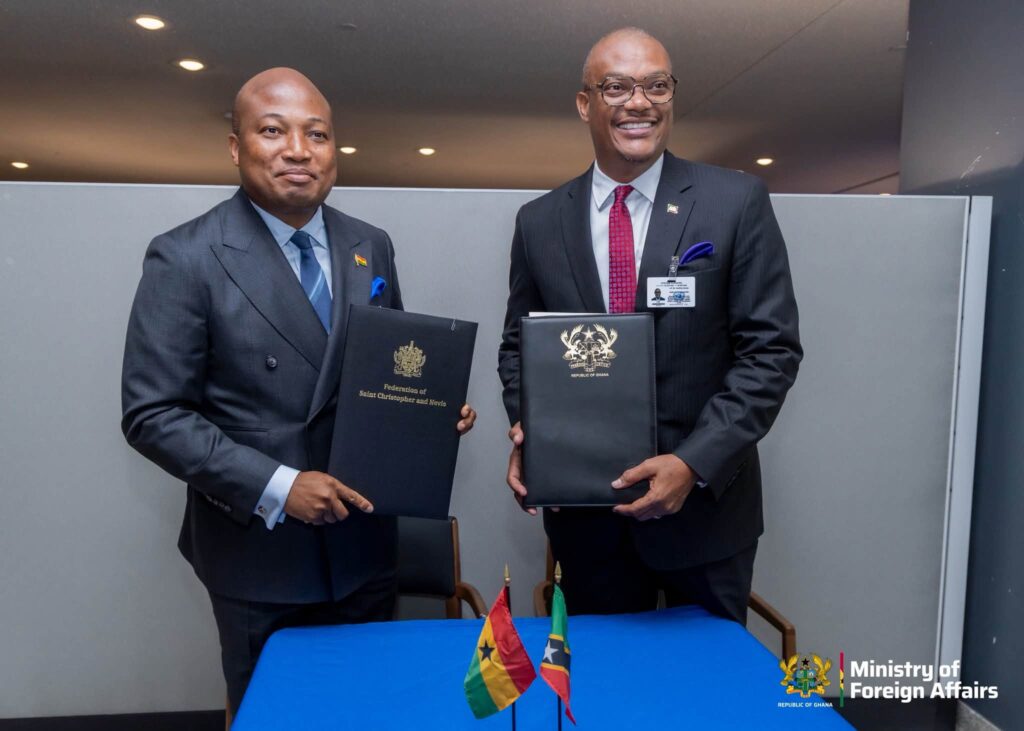
Ghana and Saint Kitts and Nevis sign nurses’ labour agreement

Ghana and Saint Kitts and Nevis sign nurses’ labour agreement

The two governments have signed an additional bilateral labour agreement covering Ghanaian nurses recruited to work in Saint Kitts and Nevis. The reported protections include enhanced salaries, health insurance, rent allowances and end-of-service benefits. Counsel advising recruits or recruitment bodies should obtain the agreement and deployment contracts to establish eligibility, implementation arrangements and enforcement mechanisms, which the report does not specify.

Ghana and Saint Kitts and Nevis have signed an additional bilateral labour agreement to provide enhanced employment conditions for Ghanaian nurses recruited to work in the Caribbean country.

The agreement was signed in New York on the sidelines of the United Nations General Assembly by Ghana’s Foreign Affairs Minister, Samuel Okudzeto Ablakwa, and Deputy Prime Minister of Saint Kitts and Nevis, Dr Geoffrey Hanley.

The deal provides for improved conditions of service for Ghanaian nurses, including enhanced salaries, health insurance and rent allowances.

The agreement also guarantees end-of-service benefits and other labour rights for the Ghanaian professionals who will be deployed to Saint Kitts and Nevis.

Mr Ablakwa described the pact as an important addition to bilateral cooperation between the two countries and said it would ensure that Ghanaian nurses receive stronger protections while working abroad.

“Ghana will continue to pursue impactful diplomacy which benefits the people we serve,” Mr Ablakwa said in a Facebook post on Monday.

He also commended Ghanaian professionals for their contribution internationally, noting that countries continue to seek their services and expertise.

Read at MyJoyOnline →
Ghana · Procedure

National Service Authority opens enrolment for approved applicants

National Service Authority opens enrolment for approved applicants

The National Service Authority has released PIN codes for approved private candidates, past defaulters and foreign-trained graduates for the 2026/2027 service year. Approved applicants must complete enrolment within the Authority’s communicated timelines and report discrepancies in their personal information. This provides a compliance route for affected graduates under the statutory service obligation, but the report specifies neither the enrolment deadline nor any waiver of consequences for earlier default.

The National Service Authority (NSA) has released PIN codes for qualified private candidates, past national service defaulters and foreign-trained graduates for the 2026/2027 national service year.

A statement dated Monday, September 28, 2026, issued by the NSA management said 3,129 applications have been approved out of 7,794 applications received by the Authority.

The NSA said the release followed the completion of registration, payment, verification and approval processes.

The exercise covers eligible Ghanaians who previously defaulted were unable to undertake their mandatory national service, as well as private candidates and graduates trained outside Ghana.

The NSA said 4,722 of the 7,794 applications received had been paid for, while 3,072 were awaiting payment.

It said 3,129 applications had been approved, 1,558 were pending approval and 35 had been rejected.

The NSA urged approved applicants to check their National Service PIN codes and complete the enrolment process within the timelines communicated by the Authority.

It also advised applicants to check the personal information linked to their PIN codes and report any discrepancies.

Applicants who encounter problems with their registration were advised to contact the appropriate NSA office for assistance.

The NSA reminded eligible Ghanaian graduates that national service remained a statutory obligation.

It urged applicants who had been issued PIN codes to comply with the requirements and timelines communicated by the Authority to facilitate their enrolment and deployment.

Connect With Us : 0242202447 | 0551484843 | 0266361755 | 059 199 7513 |

Read at Graphic Online →