
§ Briefing, Thursday, 1 October 2026

Tax arbitration and parliamentary scrutiny lead today's legal developments

Ghana reports a US$393 million tax arbitration victory, while the Speaker rejects a narcotics inquiry motion over pending proceedings. Audit enforcement and tertiary recognition also require practitioners’ attention.

Ghana · Judgment

ICC tribunal upholds Tullow insurance-proceeds tax assessment

ICC tribunal upholds Tullow insurance-proceeds tax assessment

According to the Ministry of Finance, an International Chamber of Commerce tribunal dismissed Tullow Ghana Limited’s claims and upheld the GRA’s US$393,091,993.70 assessment concerning business interruption insurance proceeds. The Ministry reports that the tribunal found no breach of the Petroleum Agreements and upheld the penalty, the timeliness of the assessment and the lawfulness of enforcement. The award matters to petroleum-sector tax advice, but practitioners should obtain its reasoning before drawing wider conclusions or treating it as resolving the separate loan-interest deduction dispute.

The Ghana Revenue Authority (GRA) has secured a US$393.09 million tax ruling against Tullow Ghana Limited after an international arbitral tribunal dismissed the company’s claims and upheld the tax assessment in full.

The Ministry of Finance in a press statement said the tribunal, constituted under the Rules of Arbitration of the International Chamber of Commerce (ICC), delivered its award on September 29, 2026, in favour of Ghana.

The case concerned the taxation of proceeds Tullow received under its corporate Business Interruption Insurance policy.

The dispute began after the GRA issued Tullow a corporate income tax assessment in December 2022 in relation to the insurance proceeds.

Tullow subsequently challenged the assessment and referred the dispute to ICC arbitration in London in February 2023.

The company also referred a separate tax dispute to arbitration over a revised assessment relating to the disallowance of loan-interest deductions. Tullow had said the two disputed assessments totalled US$387 million, plus penalties.

In a statement issued on September 30, 2026, the Ministry of Finance said the tribunal dismissed all the claims brought by Tullow and upheld the GRA’s assessment of US$393,091,993.70.

It said the tribunal also found that the assessment did not breach the Petroleum Agreements, the penalty was properly applied, the assessment was not time-barred and the GRA’s enforcement action was lawful.

Finance Minister Dr Cassiel Ato Forson commended the Office of the Attorney-General, the GRA and Ghana’s external legal counsel, Foley Hoag LLP, for their work in defending Ghana’s position.

He said the ruling came as Ghana and its Jubilee partners worked to maximise the potential of the Jubilee and TEN fields.

Dr Forson said the government had engaged Tullow before the tribunal delivered its award in an effort to reach an amicable resolution to outstanding tax matters.

He said those discussions would continue and would cover both the matter determined by the tribunal and a separate proceeding concerning the disallowance of loan interest.

The government, according to the statement, would work with Tullow to implement the award in accordance with Ghanaian law.

It said the implementation would take into account the continuity of operations in the Jubilee and TEN fields and Tullow’s capacity to sustain the investments required in the fields.

The Ministry of Finance said Tullow remained an important partner to Ghana and the country’s largest petroleum producer.

It said the company’s operations in the Jubilee and TEN fields supported energy security, domestic gas supply and thousands of livelihoods.

The ministry said Ghanaian law gave the GRA the authority to determine the time and manner in which assessed tax liabilities were paid.

It said the government’s objective was to secure revenues due to the Ghanaian people while allowing Tullow to continue operating and investing in Ghana as a going concern.

The ministry also said the government had begun discussions with Tullow before the tribunal’s award in an effort to resolve outstanding tax matters amicably and those discussions would continue.

Connect With Us : 0242202447 | 0551484843 | 0266361755 | 059 199 7513 |
Read at Graphic Online →
Ghana · Procedure

Speaker rules narcotics inquiry motion inadmissible

Speaker rules narcotics inquiry motion inadmissible

The Speaker rejected a Private Member’s motion for a parliamentary inquiry into narcotics seizures linked to Ghana, invoking Standing Orders 5, 6 and 103(f). He held that the proposed inquiry substantially overlapped with ongoing investigations and criminal proceedings and could prejudice parties by addressing issues for the courts. The ruling is relevant to the drafting of parliamentary oversight motions where litigation is pending, particularly the scope and timing of proposed terms of reference.

The Speaker of Parliament, Alban Sumana Kingsford Bagbin, has dismissed a Private Member’s motion seeking parliamentary inquiry into a series of reported narcotics seizures linked to Ghana in recent times.

He ruled that the motion was inadmissible because its proposed inquiry substantially overlapped with ongoing investigations and criminal proceedings before the courts, creating a risk of prejudicing the interests of parties involved.

Acknowledging that the matter fell within his jurisdiction as Speaker, he said he had carefully considered the motion, its proposed terms of reference, the investigations already underway and the pending court proceedings before arriving at his decision.

Giving his ruling during an emergency sitting of the House yesterday, Mr Bagbin said the proposed parliamentary inquiry could require Parliament to determine issues that properly fell within the remit of the courts.

“The combined effects of undertaking this evaluation, assessment and investigation would be, at the end of the day, to determine the very issues that the court of competent jurisdiction is supposed to determine,” he said.

“Accordingly, I am of the considered opinion that permitting the motion to proceed in its present form as presented by a Leader of the House at this particular time may prejudice the interests of parties to pending judicial proceedings. I, therefore rule, pursuant to Standing Orders 5, 6, and 103 (f), that the private member's motion is inadmissible,” he ruled.

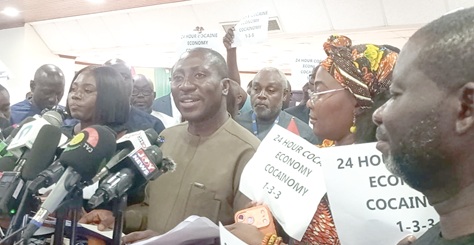
The ruling followed a petition by the Minority Caucus for the House to be recalled to consider what it described as matters of urgent national importance.

The petition was triggered by the seizure by French authorities of nearly 3.9 tonnes of cocaine at the Port of Dunkirk from a container reportedly originating from Ghana.

The Minority subsequently filed a Private Member’s motion seeking the establishment of an ad hoc committee to investigate the circumstances surrounding the shipment and other major narcotics seizures linked to Ghana.

Mr Bagbin, however, stressed that his ruling did not prevent Parliament from exercising its constitutional oversight responsibilities over narcotics trafficking, port security, border controls or the performance of state institutions.

It is not a determination of the underlying allegations,” he said.

He explained that the Minority had met the constitutional requirement for an extraordinary sitting, with the members who petitioned him representing more than the 15 per cent threshold required under Article 112(3) of the 1992 Constitution.

The Speaker, however, stressed that summoning Parliament did not automatically mean that the substantive matter in the petition had been approved for debate.

According to him, any member seeking a substantive decision of the House was required to comply with the procedures prescribed by the Constitution and the Standing Orders.

The motion, filed on Monday, September 28, by the First Deputy Minority Whip and Member of Parliament for Tolon, Habib Iddrisu, under Standing Order 102, sought the establishment of a committee under Article 103 of the Constitution and Order 262 of the Standing Orders.

The proposed committee was expected to conduct what the sponsor described as a “total, transparent and full-scale bipartisan enquiry” into major narcotics seizures linked to Ghana.

Mr Bagbin cited Standing Order 103(f), which provides that a motion shall not be the subject matter of an action on which a judicial decision is pending where, in the Speaker’s opinion, consideration of the matter may prejudice the interests of parties to the action.

He said national investigative and law-enforcement bodies had already commenced investigations into the reported narcotics seizures and that some of those processes had progressed into criminal proceedings before courts of competent jurisdiction.

He said official searches available to him indicated that four substantive narcotics-related cases connected to the matters covered by the proposed inquiry were pending before the courts, involving about 21 persons standing trial.

The Speaker said a parliamentary committee could be required to hear evidence and witnesses on factual matters that could simultaneously arise in the pending criminal proceedings.

“There is, therefore, substantial overlap between the proposed parliamentary fact-finding exercise and matters presently engaging investigative bodies and the courts,” he said.

“That raises precisely the concern contemplated by Standing Order 103 (f),” he added.

Mr Bagbin referred to previous parliamentary discussions on the relationship between parliamentary proceedings and pending judicial cases, saying the sub judice rule did not automatically prohibit Parliament from considering matters connected to litigation.

He said the critical consideration was whether parliamentary proceedings created a sufficient risk of prejudice to parties involved in pending judicial proceedings.

The Minority Leader, Alexander Afenyo-Markin, however, stated that the Speaker got it all wrong in dismissing the Private Member’s Motion seeking parliamentary inquiry into a series of narcotics seizures linked to Ghana.

He said the ruling by Mr Bagbin improperly curtailed Parliament’s constitutional oversight powers.

In his view, the Speaker erred in relying on pending court cases to prevent Parliament from investigating the administration and effectiveness of public institutions connected to the narcotics incidents.

Addressing the press after the Speaker’s ruling during an emergency sitting, Mr Afenyo-Markin described the development as “a sad day for democracy and parliamentary oversight” and accused the Majority Caucus of using its numbers, with the support of the Speaker, to weaken Parliament.

“Mr Speaker tells us that there are certain matters before the court but he does not explain to us how these matters oust the constitutional jurisdiction of Parliament to enquire into the conduct, administration and effectiveness of public institutions involved in the matter.

“The Majority are resisting scrutiny and they quickly welcomed the Speaker’s decision and moved to adjourn the sitting,” he said.

The Minority Leader said the Minority-sponsored motion did not seek to interfere with criminal proceedings or determine the guilt or innocence of accused persons but rather to examine whether state institutions had effectively discharged their responsibilities.

He said Articles 93(2) and 103 of the 1992 Constitution vested legislative and oversight powers in Parliament, with Article 103(3) expressly empowering parliamentary committees to investigate and enquire into the activities and administration of ministries, departments and agencies.

He further cited Article 103(6), which gave parliamentary committees the powers, rights and privileges of the High Court for purposes including compelling witnesses to attend, examining them and requiring the production of documents.

“These provisions, we submit, are important because the motion we filed before the House does not seek to try any accused person”.

Read at Graphic Online →
Ghana · Procedure

Auditor-General outlines surcharge process and recovery tracking

Auditor-General outlines surcharge process and recovery tracking

The Auditor-General has pledged to exercise constitutional disallowance and surcharge powers against unlawful expenditure and announced an online Audit Recommendations Tracker for October 2026. She described a process involving notice and 14 days to respond, followed by a certificate where the response is unsatisfactory and a 60-day appeal period. Counsel advising public institutions and affected officers should prepare promptly for notices and verify the applicable service requirements and appeal deadlines rather than rely solely on the reported announcement.

Dr Pamela Graham, the Auditor-General, has pledged to fully exercise her constitutional powers of disallowance and surcharge against persons found to have incurred unlawful expenditure.

She also announced that the Ghana Audit Service would, from October 2026, deploy an Audit Recommendations Tracker on its website to publicly monitor implementation of audit recommendations and provide visibility on recoveries.

Dr Graham, Ghana’s first female Auditor-General, announced this at the launch of the 2026 financial year audit in Accra, on the theme: “Strengthening accountability in public institutions: Building trust through collaboration and action.”

As of February 2026, about GH¢280.5 million in surcharges remained outstanding, while approximately GH¢57.2 million had been collected through the Auditor-General’s recovery account since 2022.

“Where our work establishes that expenditure has been incurred contrary to the law, I will exercise the powers of disallowance and surcharge that the Constitution vests in the Auditor-General,” Dr Graham said.

She, however, said the Service would not impose surcharges arbitrarily, explaining that persons affected would first be issued notices to respond within 14 days.

Where the response was deemed unsatisfactory, she said, a certificate would be served, with a 60-day period within which an appeal could be lodged.

Dr Graham said every cedi lost through financial irregularities represented resources that could otherwise be invested in education, healthcare, infrastructure and social protection.

“The resources we audit belong to the people of Ghana; every cedi lost through weak controls, unlawful expenditure, inefficiency or failure to act, is a cedi withheld from education, healthcare, infrastructure and social protection. That is the meaning of accountability, and that is how public trust is built,” she said.

She said the responsibility of auditors went beyond identifying what had gone wrong.

It involved establishing the facts, applying the law, ensuring that weaknesses were addressed and helping to prevent similar failures from recurring.

On technology, Dr Graham said the Audit Service would expand the use of data analytics, data-driven auditing and appropriately governed artificial intelligence to move progressively beyond limited samples to whole-population analysis, where data quality permitted.

She said the Service had also developed an in-house Correspondence Management System to receive and manage official communications from audited entities.

The system, she said, would improve efficiency and traceability while reducing reliance on paper, in line with environmental, social and governance requirements.

Dr Graham said the Audit Recommendations Tracker, to be deployed in October 2026, would show implemented and outstanding recommendations, amounts identified, pursued and recovered, as well as systemic weaknesses that continued to expose public resources to risk.

She said the 2026 audit would be anchored on five pillars: continuous engagement, timeliness, technology, people and impact.

The approach, she said, was intended to ensure that the accountability chain did not end after audit reports were tabled in Parliament.

Dr Graham emphasised the need for timely auditing, citing Article 187(5) of the 1992 Constitution, which requires the Auditor-General to submit reports to Parliament within six months after the end of each financial year.

She urged all covered entities to prepare and submit their records on time to facilitate the audit process.

She said the Service’s mandate covered more than 7,000 institutions annually, including over 5,000 Ministries, Departments and Agencies and Metropolitan, Municipal and District Assemblies.

The mandate also covered thousands of pre-tertiary educational institutions, 116 state-owned enterprises, 79 public boards and corporations, 60 traditional councils, as well as donor-funded and other special audit entities nationwide.

Madam Abena Osei-Asare, Chairperson of the Public Accounts Committee, expressed concern about the GH¢280.5 million in outstanding surcharges.

“The problem is not enough reporting; it’s also not enough even debating on it in Parliament, without enough follow-through,” she said.

She urged a shift from episodic to continuous accountability, with technology-enabled systems linking procurement records, payroll data, tax reports and asset registers to detect anomalies early, before they resulted in audit findings and financial losses.

The PAC Chairperson said accountability was ultimately about public trust.

“When it fails repeatedly, the nation loses more than money – it loses public trust, which is far more difficult to recover than money,” she said.

Professor Francis Dodoo, Presidential Advisor on the National Anti-Corruption Programme, urged the Audit Service to fully enforce its punitive powers to deter misappropriation.

He urged the Auditor-General to make surcharge rates sufficiently punitive, including setting them above prevailing Treasury bill market rates, to strengthen their deterrent effect and ensure stricter enforcement of recoveries.

Dr David Ofosu-Dorte, Legal and Business Strategist, supported the exercise of disallowance and surcharge powers but cautioned that some audit reports had been successfully challenged in court over quality-related lapses.

He, therefore, called for stronger training and professional capacity within the Audit Service to improve the quality of audit reports.

Dr Ofosu-Dorte also urged greater coordination among the Police Service, Internal Audit Agency, Value for Money Office and Office of the Special Prosecutor to prevent financial losses while avoiding unnecessary duplication of audits.

He said such coordination should also help prevent the harassment of investors whose activities were subject to regulatory and audit scrutiny.

Dr Ofosu-Dorte further urged the Service to move urgently from manual auditing to technology-driven systems, including the adoption of AI-assisted accounting and auditing tools.

Read at MyJoyOnline →
Ghana · Regulation

GTEC identifies more than 100 unrecognised tertiary institutions

GTEC identifies more than 100 unrecognised tertiary institutions

The Ghana Tertiary Education Commission has identified more than 100 tertiary institutions as unrecognised as of September 2026 and urged verification before enrolment or reliance on their certificates. The warning is relevant to education-sector compliance, employment screening and advice on qualification requirements. Practitioners should check the Commission’s actual list and the status of the institution concerned, since the report does not establish the legal consequences for every affected qualification.

The Ghana Tertiary Education Commission (GTEC) has identified more than 100 tertiary institutions operating without recognition as of September 2026, citing various quality assurance concerns.

In a statement on unrecognised tertiary institutions, the Commission warned prospective students, parents and the general public to exercise caution when considering enrolment at the affected institutions.

GTEC said the institutions on its list have not been recognised by the Commission, meaning their operations and the qualifications they offer remain subject to concerns identified through its quality assurance processes.

The Commission urged prospective students and parents to verify the recognition status of any tertiary institution before enrolling. It also advised members of the public to conduct the necessary checks before accepting or relying on certificates issued by institutions whose recognition status has not been established.

GTEC further cautioned the public to exercise due diligence regarding certificates obtained from the listed institutions, stressing the importance of confirming their status before using them for employment, further education or other purposes.

Read at MyJoyOnline →
Ghana · Profession

Ghana Law Society formally launched

Ghana Law Society formally launched

The Ghana Law Society was formally launched by the Speaker of Parliament at its inaugural Annual Bar Conference on September 30. The event establishes a further professional association through which lawyers may engage in legal and institutional reform. The report describes an association launch, not a change to statutory professional regulation, admission requirements or rights of audience.

The Ghana Law Society, a new association for lawyers in Ghana has been officially launched.

It was launched by the Speaker of Parliament, Alban Sumana Kingsford Bagbin at the maiden edition of the association’s Annual Bar Conference in Accra on Wednesday (September 30, 2026).

Present at the event included the Chief of Staff, Dr Julius Debrah, the Speaker of Parliament, Alban S.K. Bagbin, the Attorney General and Minister of Justice, Dr Dominic Ayine and a representative from the Chief Justice’s Office.

The conference which was held on the theme: “Legal reforms — the place of the Ghanaian lawyer,” brought together members of the legal profession, the Judiciary, Parliament, government and other stakeholders.

The official launch of the GLS also follows its establishment as a new association within the country’s legal profession.

The Speaker, Mr Bagbin, said the Ghanaian lawyer had never been limited to courtroom advocacy and had historically contributed to constitutional development, human rights, commerce, public administration, diplomacy and parliamentary work.

He described the lawyer as an “architect of the Republic”, saying lawyers had a responsibility to examine not only what the law was but also what it ought to become.

Mr Bagbin said the country was engaged in constitutional and institutional reforms and that the legal profession had a responsibility to contribute to the process.

He said constitutionalism was sustained by citizens and professionals who believed that the law should remain superior to convenience, power and partisan interests.

He further cautioned that passing legislation alone did not produce justice.

“A beautifully crafted Act of Parliament, that cannot be implemented, [is] little more than an elegant promise,” he said.

He said legal reform should therefore be measured by whether citizens had meaningful access to justice, whether cases were determined within reasonable time and whether legal institutions were keeping pace with technological changes. Law, economy

The Chief of Staff, Julius Debrah, said legal reform should also be viewed as an economic issue because the effectiveness of the legal system had implications for investment, business and economic activity.

He said businesses needed enforceable contracts, farmers needed certainty over land ownership, while young innovators needed clear rules on areas such as data, digital assets and artificial intelligence.

Dr Debrah said efficient laws could reduce risk, protect rights and provide businesses with the certainty required to grow.

He said the government had embarked on a number of reforms, including the Legal Education Act, 2026, the Community Service Act, 2026, the Tribunal Act, 2026, and the constitutional review process.

He said the legal profession had a role to play in ensuring that such reforms translated into practical improvements in the lives of citizens.

Dr Debrah also called for attention to access to justice, commercial and regulatory certainty, constitutional obligations, criminal justice and the preparedness of the legal profession for emerging technologies.

He said legal reform should not end with the passage of legislation but should include implementation, resources, measurable targets and public reporting.

The Attorney-General and Minister of Justice, Dr Dominic Ayine, said the success of the country’s legal reform agenda would depend partly on the role lawyers chose to play in the process.

He urged lawyers to contribute to legislative drafting, the reform of state contracts, public financial management, disciplinary reform and access to justice instead of limiting themselves to commenting on laws after they had been passed.

Dr Ayine also called for professional independence, saying lawyers’ associations needed to maintain their independence from political parties and the State.

He said the legal profession should be able to speak on the state of the law and the courts without being seen as speaking for a political interest.

He said the government’s constitutional review process also required greater input from the legal profession as proposals moved towards the legislative stage.

“The place of the Ghanaian lawyer, in this season of reform, is to be independent enough to be believed and engaged enough to matter,” he said.

The President of the GLS, Rockson-Nelson Etse Kwami Dafeamekpor, said one of the major challenges confronting the legal profession was the concentration of lawyers in a few urban centres.

He said Ghana had fewer than 8,000 lawyers with active practising certificates, with more than 72 per cent practising within Accra, Kumasi and Tema.

Mr Dafeamekpor said more than 190 districts had no law firm, leaving citizens in some parts of the country to travel long distances for services such as land searches, tenancy agreements, bail applications and legal representation for juveniles.

He said the situation required the profession to rethink how lawyers were trained, posted and made available to citizens.

“We cannot continue to be a Bar of Accra, by Accra, for Accra. We must be a Bar of Ghana, by Ghana, and for Ghana,” he said.

As part of measures to address the situation, he announced a proposed 12-month structured national service programme for newly qualified lawyers, under a partnership between the GLS and the National Service Secretariat.

Under the proposal, fresh lawyers would be posted to district assemblies, Legal Aid offices, CHRAJ offices, the Judicial Service, Lands Commission offices and regional offices of the Attorney-General to provide legal services and support justice delivery.

Mr Dafeamekpor said the GLS would pursue reforms in legal education, national service for newly qualified lawyers, mandatory pro bono work, digitisation, specialisation, professional welfare and legal scholarship.

Mr Dafeamekpor said the reforms were intended to ensure that the legal profession became more responsive to the needs of citizens and the changing demands of the country.

Connect With Us : 0242202447 | 0551484843 | 0266361755 | 059 199 7513 |

Read at Graphic Online →
Ghana · Procedure

Petition seeks accountability for alleged fatal shooting during mining operation

Petition seeks accountability for alleged fatal shooting during mining operation

Residents of Akyem Hemang have petitioned the district authorities for an investigation into the death of Douglas Acheampong, allegedly shot by suspected military personnel during an operation at a mining site. The District Chief Executive undertook to forward their concerns to the appropriate authorities; the report establishes neither responsibility nor a completed investigative finding. The legal significance concerns accountability for allegedly lethal state force and access to an effective investigation, rather than any determination of criminal liability.

On August 26, 2026, Douglas Acheampong, a 29-year-old resident of Akyem Hemang near Osino in the Eastern Region was allegedly shot at an illegal mining site which led to his death.

Some residents in the area claim Douglas was shot at close range from the back by personnel said to be military men.

Following this, they organised residents from Akyem Hemang and surrounding communities near Osino in the Fanteakwa South District to stage a street protest on Tuesday (Sept 29) demanding justice and for the alleged killers of Douglas Acheampong to be arrested.

They claim Douglas Acheampong was shot and killed by the said military personnel during an operation at the mining site.

Wearing red armbands and carrying placards with various inscriptions such as "Douglas deserves justice", "Douglas blood cries for justice", "Stop the brutality","Uphold human dignity", "Military must serve not kill" and "Justice for Douglas" they marched through the streets and presented a petition to the District Chief Executive for Fanteakwa South, Mercy Korang.

The Assembly Member for the area, Richmond Darko alleged that Douglas Acheampong was shot from behind while fleeing the scene after security personnel reportedly fired warning shots into the crowd.

He therefore called for a thorough investigation into the circumstances which led to the sudden death of Acheampong and want anyone found responsible to face the full rigours of the law.

The Fanteakwa South District Chief Executive, Mercy Korang after receiving the petition assured that their concerns would be forwarded to President Mahama and all the appropriate quarters for the necessary action to be taken to ensure justice.

The DCE appealed to the protestors as well as the residents of the area to continue to remain calm and be patient as the matter was being addressed through the appropriate channels.

Writer's email: This email address is being protected from spambots. You need JavaScript enabled to view it.

Connect With Us : 0242202447 | 0551484843 | 0266361755 | 059 199 7513 |

Read at Graphic Online →