§ Briefing, Saturday, 3 October 2026

Custody safeguards and proposed Bar training reform

EOCO’s planned court appearance for a detained MP puts custody safeguards in focus. Other developments concern proposed lawyer training reform, an ITLOS appointment and the legal basis for beachfront demolitions.

Ghana · Procedure

EOCO seeks weekend court appearance for Baffour Awuah

EOCO seeks weekend court appearance for Baffour Awuah

EOCO says it is working with the Attorney-General’s Office to bring Manhyia South MP and lawyer Nana Agyei Baffour Awuah before a weekend court following his surrender at 10 a.m. on 1 October. The agency invokes constitutional timeframes and bail requirements, and denies reports that it granted GH¢50 million bail. The report also records a disputed claim that investigators intended to search his residence although the court order authorised a search of his law firm. Practitioners should distinguish the agency’s stated intention from an actual court appearance and examine the warrant’s terms before drawing conclusions about the search’s legality.

The Economic and Organised Crime Office (EOCO) says it is working with the Attorney-General’s Office to bring Manhyia South MP Nana Agyei Baffour Awuah before a weekend court following his voluntary surrender to the agency.

In a statement issued on Friday, October 2, EOCO said the move is in line with the constitutional timeframes and procedural requirements governing bail.

The MP voluntarily surrendered to EOCO at 10 a.m. on Thursday, October 1, and is cooperating with the Office as investigators continue with the necessary investigative, procedural and operational processes.

EOCO said it was "fervently working with the Office of the Attorney-General to bring the Suspect before a weekend court."

The statement also dismissed reports that the MP had been granted GH¢50 million bail, urging the public to disregard such reports.

EOCO said investigations and other procedural processes involving the MP remain ongoing.

The development follows heightened attention surrounding the investigation involving the Manhyia South MP and his earlier interactions with EOCO.

Earlier today, Minority Leader Alexander Afenyo-Markin questioned EOCO's decision to search the residence of Manhyia South MP, claiming the court order obtained by the agency was specifically for a search of his law firm.

Mr Afenyo-Markin said the issue arose on Friday, October 2, after EOCO informed the detained MP that investigators intended to search his residence.

Speaking to the media after visiting Mr Awuah in EOCO custody, he said the MP found the decision puzzling because, according to him, the court order obtained by EOCO specifically authorised a search of the MP’s law firm in Dzorwulu.

“The court order that was procured by EOCO was very clear that they should only search his office, his law firm at Dzorwulu,” he said.

Mr Afenyo-Markin said the court had also directed that the order be served on the Speaker of Parliament, Alban Bagbin.

Read at MyJoyOnline →
Ghana · Profession

Ghana Law Society proposes national service in place of pupillage

Ghana Law Society proposes national service in place of pupillage

The Ghana Law Society has proposed replacing six-month pupillage with a structured 12-month national service programme jointly administered with the National Service Secretariat. Proposed placements include district assemblies, the Legal Aid Commission, CHRAJ and the Judicial Service, with training and supervision intended to improve access to legal services outside major cities. This remains a proposal, with an MoU expected this year, rather than an established change to professional qualification requirements. Chambers and newly qualified lawyers should await confirmation of the requisite regulatory authority, supervision standards and relationship with existing pupillage obligations.

The President of the Ghana Law Society (GLS), Rockson-Nelson Etse Kwami Dafeamekpor, has announced plans to replace the current six-month pupilage for fresh lawyers with a 12-month structured national service programme.

He said the Ghana Law Society-National Service Scheme (GLS-NSS) would see newly qualified lawyers posted to districts across the country to provide legal services, while receiving structured professional training, supervision and mentorship.

In a press statement issued last Wednesday, Mr Dafeamekpor said the proposed reform was part of the society’s seven-pillar Bar Reform Programme.

He said the GLS and the National Service Secretariat (NSS) would jointly run the scheme under a Memorandum of Understanding (MoU) expected to be executed this year.

He said the reform was intended to address the uneven distribution of lawyers in the country, adding that more than 72 per cent of the fewer than 8,000 lawyers with active practising certificates practised in Accra, Kumasi and Tema, while more than 190 districts had no law firms.

The statement further explained that under the scheme, fresh lawyers would be posted to district assemblies as assistant legal officers to assist with drafting bye-laws and raising internally generated funds.

Others would serve at district offices of the Legal Aid Commission, where they would provide legal assistance to poor and vulnerable persons, while some would work as investigators at district offices of the Commission on Human Rights and Administrative Justice (CHRAJ).

The new lawyers will also serve as research assistants to district magistrates and circuit judges of the Judicial Service to support judgment writing and improve the speed of justice delivery, while others will be posted to Regional Lands Commissions to work on title registration and alternative dispute resolution or serve at regional offices of the Attorney-General to strengthen prosecutorial and civil justice.

Mr Dafeamekpor described the existing six-month pupilage as six months of carrying files, photocopying processes, loitering in corridors unpaid, unmentored, unmonitored and uninspired.

He said a country that invested heavily in training lawyers had a right to demand a year of structured national service from them, while young lawyers had a right to dignified mentorship and remuneration in return.

The statement further explained that each service lawyer would be required to keep a Pupilage Logbook and submit monthly reports to a Regional Pupil Master appointed by the GLS.

They would also complete five mandatory Continuing Professional Development (CPD) modules covering Ethics and Professional Conduct, Conveyancing and Land Governance, Advocacy and Legal Aid, Local Government Law and Legislative Drafting.

Each lawyer would have a senior mentor at the bar and a field supervisor at the place of posting.

Mr Dafeamekpor said the lawyers would receive the standard national service allowance, topped up by the proposed Ghana Law Society Pupilage Support Fund and support from development partners.

“We will no longer produce lawyers who cannot afford to be lawyers,” he said.

On completion of the programme, each lawyer would receive a Certificate of Pupilage and a Certificate of Community Service.

The two certificates would be required to renew the lawyer’s first annual Solicitor’s Licence.

“We must earn the right to private practice by first serving the public,” he said.

Read at Graphic Online →
International · Profession

Sylvia Adusu sworn in as ITLOS judge

Sylvia Adusu sworn in as ITLOS judge

Graphic Online reports that Ghanaian jurist Dr Sylvia Ama Adusu has been sworn in to the International Tribunal for the Law of the Sea, becoming its first African woman judge. Her nine-year term commenced on 1 October 2026, following election by States Parties to UNCLOS and the declaration required under Article 11 of the Tribunal’s Statute. The appointment is significant for Ghana’s international legal profession and practitioners working on maritime delimitation, marine resources and UNCLOS dispute settlement.

Ghanaian jurist, Dr Sylvia Ama Adusu, has been sworn in as a member of the International Tribunal for the Law of the Sea (ITLOS), becoming the first African woman to serve on the international maritime court.

Dr Adusu was sworn in alongside four other newly elected judges at a public sitting of the Tribunal in Hamburg, Germany, yesterday, to begin their nine-year terms ending in 2035.

The other judges are George Rodrigo Bandeira Galindo of Brazil, Slim Laghmani of Tunisia, Lan-Anh Thi Nguyen of Vietnam and Bimal N. Patel of India.

During the sitting, the five judges made the solemn declaration required under Article 11 of the Statute of the Tribunal to exercise their powers impartially and conscientiously.

The judges were elected at the 36th Meeting of States Parties to the United Nations Convention on the Law of the Sea (UNCLOS) to serve nine-year terms commencing October 1, 2026.

Dr Adusu’s election in June this year made her the first African woman elected to the ITLOS bench.

She secured 130 votes out of 169 votes cast at the 36th Meeting of States Parties to UNCLOS held at the United Nations Headquarters in New York.

Her election followed Ghana’s nomination and the endorsement of her candidature by the African Union.

Dr Adusu, a former Chief State Attorney and former head of the International Law Division of the Office of the Attorney-General and Ministry of Justice, has more than three decades of experience in legal practice and international law.

She holds a PhD in International Law from the University of Lancaster in the United Kingdom, with research focused on the delimitation and conservation of marine resources under UNCLOS within the context of cooperation over Gulf of Guinea resources.

Her experience in the law of the sea includes working on major cases involving Ghana before international tribunals.

She was a member of Ghana’s legal team in the “ARA Libertad” case involving Argentina and Ghana before ITLOS and served as counsel in Ghana’s maritime boundary dispute with Côte d’Ivoire before the tribunal. She was also part of Ghana’s maritime boundary negotiating team.

The Ghana-Côte d’Ivoire case concerned the delimitation of the maritime boundary between the two countries in the Atlantic Ocean and was heard by ITLOS in Hamburg.

Dr Adusu has also represented Ghana in international legal proceedings, including proceedings before the International Court of Justice on the request for an advisory opinion on climate change.

ITLOS is an independent judicial body established by the 1982 United Nations Convention on the Law of the Sea.

It has jurisdiction over disputes concerning the interpretation or application of the convention and other matters specifically provided for in agreements conferring jurisdiction on the tribunal.

Its work covers disputes involving maritime boundaries, navigation, conservation and management of living marine resources, protection and preservation of the marine environment and marine scientific research.

On September 17, 2017, ITLOS successfully settled a dispute concerning delimitation of the maritime boundary between Ghana and Côte d'Ivoire in the Atlantic Ocean.

Read at Graphic Online →
Ghana · Procedure

SSNIT explains request for La beachfront clearance

SSNIT explains request for La beachfront clearance

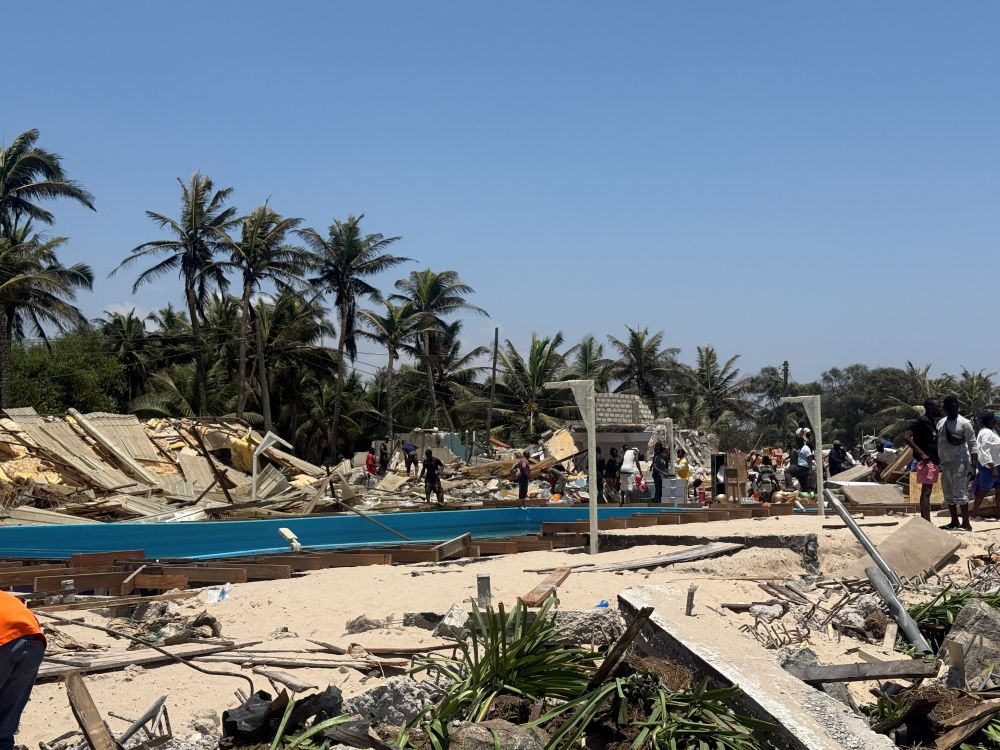
SSNIT says it sought National Security Council Secretariat intervention against what it describes as unlawful occupation and encroachment adjoining its Labadi Beach and La Palm Royal Beach hotel investments. Military and police personnel carried out demolitions on 2 October, affecting businesses and other structures. SSNIT invokes its fiduciary responsibility to contributors and pensioners, but the supplied report does not establish the legal authority, notice process or any court order supporting the clearance. For affected operators and investment advisers, the immediate issues are the underlying land rights and whether the enforcement process complied with applicable legal safeguards.

The Social Security and National Insurance Trust (SSNIT) has, in a statement issued by its Board of Trustees, explained its decision to seek the removal of structures and unauthorised occupants from the beachfront adjoining the Labadi Beach Hotel and La Palm Royal Beach Hotel in Accra.

The clarification follows a demolition exercise on Friday, October 2, which affected several structures and businesses along the La Beach area, including La Pleasure Beach and Polo Beach Club.

The operation, involving personnel from the 48 Engineer Regiment of the Ghana Armed Forces and the Ghana Police Service, began in the early hours of Friday, with security personnel directing workers, traders, residents and operators to vacate the area. Several structures were subsequently demolished or partially pulled down.

In a statement issued on Friday, October 2, SSNIT said it had sought the urgent intervention of the National Security Council Secretariat to address what it described as the “persistent unlawful occupation, encroachment, and unauthorised activities” on the beachfront adjoining and directly in front of the two hotels.

SSNIT said the Labadi Beach Hotel and La Palm Royal Beach Hotel form part of its investment portfolio and constitute significant national hospitality and tourism assets.

It said it therefore had a fiduciary responsibility to protect the investments, preserve their value and ensure that they continued to generate sustainable returns for contributors and pensioners under the Basic National Social Security Scheme.

“These assets belong to the workers and pensioners of Ghana,” SSNIT stated.

According to SSNIT, the continued encroachment on the beachfront presented a number of risks to the hotels and their operations.

The Trust cited concerns about the safety and security of hotel guests, employees, service providers and visitors, as well as unauthorised access and proximity to sensitive guest and operational areas.

It also identified increased exposure to fire, sanitation, environmental and public-health hazards as among the concerns associated with the continued occupation of the beachfront.

SSNIT said the situation had also affected the condition of the beachfront, the privacy of the hotels and the service standards expected of internationally recognised hospitality facilities.

It further raised concerns about the degradation of the coastal ecosystem, particularly as a result of construction activities on the beachfront and beach sand.

The Trust said the situation could also cause reputational damage to the hotels, SSNIT and Ghana’s tourism industry.

Another concern, it said, was the potential disruption of hotel operations and the guest beach experience, which could adversely affect patronage, revenue and the hotels’ overall financial performance.

SSNIT also cited the risk that further expansion of the encroachments could make recovery of the affected areas increasingly difficult and costly.

“In view of the foregoing, SSNIT requested support from National Security to protect the assets belonging to Ghanaian workers,” the statement said.

The demolition initially generated questions about whether it formed part of the Government’s ongoing flood mitigation operations in parts of Accra. Deputy Chief of Staff in charge of Operations, Stan Dogbe, subsequently clarified that Friday’s action was separate from the Government’s flood mitigation exercise.

He said the operation was carried out under the supervision of National Security at the request of the Labadi Beach Hotel.

Mr Dogbe said the structures affected, including the Polo Beach Club and other permanent structures, were located on the beach in front of the hotel and, according to the hotel, were affecting its safety, tranquillity and reputation, while diminishing the visitor experience.

He also distinguished the exercise from the work of the Government’s National Flood Mitigation Task Force at locations including the Kpeshie Lagoon, East Legon Boundary Road, Oyarifa and behind Mayfair Estates. Mr Dogbe said there were also broader sanitation and security concerns associated with unauthorised and unregulated commercial activities along the beachfront.

SSNIT said the exercise was not intended to prevent the public from accessing the beach. It said the affected areas would be cleaned and restored to a safe and desirable condition.

“The beaches will be cleaned and restored to a safe and desirable state and will remain open to the public,” the Trust stated.

SSNIT did not, in the statement, announce plans to convert the cleared beachfront into a private facility or restrict public access.

Rather, it said its intervention was aimed at protecting the hotels and the underlying investments while addressing the issues it had identified on the beachfront.

The exercise has, however, affected a number of businesses and workers operating in the area. The La Dadekotopon MP, Rita Naa Odoley Sowah, confronted military personnel at La Pleasure Beach and questioned the basis for the exercise.

She said she had engaged authorities over the planned demolition and had been assured that structures around the Labadi Beach Hotel would not be affected. Some operators also complained about the destruction of their businesses and property, with affected workers seen salvaging belongings from demolished structures.

The demolition also followed earlier clearance activities in parts of the La Beach area, including structures at Laboma Beach. However, officials have stressed that Friday’s operation near the Labadi Beach Hotel should not be conflated with the Government’s separate flood mitigation programme.


Read at MyJoyOnline →