§ Briefing, Tuesday, 6 October 2026

SkyTrain adjournment and offshore licensing scrutiny lead

The SkyTrain case management conference has been adjourned pending a listed Supreme Court application. Offshore reconnaissance licences and recurring local government audit irregularities face scrutiny.

Ghana · Procedure

SkyTrain case management conference adjourned to October 19

SkyTrain case management conference adjourned to October 19

The Accra High Court has adjourned the SkyTrain case management conference to October 19, 2026, following submissions concerning Solomon Asamoah’s application invoking the Supreme Court’s supervisory jurisdiction. The application seeks certiorari and prohibition, including restraint of further trial proceedings, and is listed for October 13; the report also records that an interlocutory injunction had been refused. Asamoah and Prof. Ameyaw-Akumfi deny charges concerning an allegedly unauthorised US$2 million GIIF payment. Practitioners should distinguish the High Court’s adjournment from any Supreme Court order staying proceedings.

The Accra High Court has adjourned the case management conference (CMC) in the US$2 million SkyTrain trial to October 19, 2026, after counsel for the first accused, Solomon Asamoah, prayed the court to allow the Supreme Court to determine his application seeking to halt the trial.

Justice Audrey Kocuvie-Tay adjourned the case to October 19, 2026, after hearing submissions from counsel for the accused persons and the prosecution.

The case management conference (CMC), which was scheduled to run from October 5 to 7, 2026, was expected to pave the way for the accused persons to open their defence after the prosecution closed its case.

Mr Asamoah and Prof. Ameyaw-Akumfi are standing trial over an alleged US$2 million payment by the Ghana Infrastructure Investment Fund (GIIF) in connection with the proposed Accra SkyTrain project, which was never constructed.

The prosecution alleges that the money was transferred from GIIF's account to Africa Investor Holdings Limited, a South African company, without the requisite approval of the GIIF Board.

The two accused persons have pleaded not guilty to the charges.

In court on Monday (October 5), counsel for Mr Asamoah, Victoria Barth, told the court that her client had invoked the supervisory jurisdiction of the Supreme Court in respect of the trial.

She said the application was for orders of certiorari and prohibition, including an order restraining the High Court from further hearing, continuing with or determining the case.

According to her, the return date for the application was October 13, 2026, and any further step in the trial before that date could compromise the application before the Supreme Court.

She said although the Supreme Court had refused Mr Asamoah's application for an interlocutory injunction to halt the trial, her client had demonstrated good faith by filing his witness statement on September 23, 2026.

She added that 14 subpoenas were subsequently filed on October 2, 2026, in respect of persons Mr Asamoah intended to cross-examine as part of his defence, depending on the outcome of the application before the Supreme Court.

“We are praying the court to take into consideration the fact that the return date for the prohibition application is Tuesday, October 13, and therefore to kindly indulge us a short adjournment for the Supreme Court to hear us,” she said.

Ms Barth further told the court that two persons who were outside the jurisdiction or presently unavailable to the defence were expected to provide witness statements, subject to the court's leave.

Counsel for the second accused, Prof. Christopher Ameyaw-Akumfi, Yaw Acheampong Boafo, associated himself with the submissions of Ms Barth.

For the prosecution, Sefakor Batse said it had been served with the witness statement of the second accused but was yet to receive that of the first accused.

She said the prosecution had also just been informed about the subsequent processes filed by the first accused.

Ms Batse said the prosecution would have preferred the CMC to proceed but would leave the matter to the discretion of the court.

She, however, reminded the court that at the previous sitting, it had been stated that the filing of processes at the Supreme Court did not automatically stay proceedings before the High Court.

Read at Graphic Online →
Ghana · Regulation

Coalition seeks review of offshore gold reconnaissance licences

Coalition seeks review of offshore gold reconnaissance licences

A coalition of fisheries and marine conservation organisations has petitioned the government to review and clarify agreements permitting GoldCoast Resource Corp’s offshore gold reconnaissance activities. The coalition says substantial portions of the reported licensed area overlap the Inshore Exclusion Zone, which it identifies by reference to the Fisheries and Aquaculture Act, 2025 (Act 1146). The petition raises questions about the relationship between mineral reconnaissance permissions, fisheries protections and proposed seabed investigations. Counsel advising operators or coastal communities should examine the actual licence terms and applicable statutory requirements; the report establishes neither licence invalidity nor a regulatory determination.

A Coalition of Civil Society Organisations (CSOs) working in the area of fisheries and marine ecosystems, has petitioned the government to review and clarify legal agreements permitting GoldCoast Resource Corp to undertake offshore gold reconnaissance activities along Ghana’s inshore waters.

In a statement copied to the Ghana News Agency (GNA), the Coalition said it had taken note of reports that the GoldCoast Resource Corp. Held ten offshore reconnaissance licences covering approximately 10,000 square kilometres, extending along about 300 kilometres of Ghana’s coastline between Half Assini in the Western, and Winneba in the Central regions, and reaching about 33 kilometres offshore.

It said though they did not oppose responsible investment or the lawful use of Ghana’s natural resources, their concern was that decisions affecting the ocean space must protect fisheries, biodiversity, food security, human rights, and coastal livelihoods.

According to the Coalition, the company’s published map indicated that substantial portions of its licensed area fell within Ghana’s Inshore Exclusion Zone (IEZ), which the Fisheries and Aquaculture Act, 2025 (Act 1146) defined as the coastal waters between the coastline and 12 nautical miles offshore.

It said: “Company disclosures indicate that approximately 50,000 line-kilometres of airborne magnetic data have already been collected across 100 per cent of the licensed area, with more detailed work focused on a 500 square kilometres priority area encompassing the mouth of the Ankobra River.

“The stated forward programme includes marine bathymetric and seismic surveys, followed by vibro-core drilling and bulk seabed sampling, but the company acknowledges that no mineral resource or reserve, or economic viability, has yet been established.”

The Coalition noted that Ghana, therefore, still had an important opportunity to determine the legal, environmental, and social implications before authorising any further phase.

It called on the government to clarify the legal position, stating that Section 32(3) of the Minerals and Mining Act, 2006 (Act 703), as amended, prohibited the holder of a reconnaissance licence from drilling or excavating.

“More fundamentally, section 99(6) of Act 703, as amended, makes it an offence to use a floating platform or other equipment for mining or dredging to obtain minerals in Ghana’s natural water bodies, including the territorial sea, exclusive economic zone and continental shelf,” it added.

It said Ghana’s expanded IEZ, the Marine Fisheries Management Plan, and the recently declared Marine Protected Area (MPA) in the Greater Cape Three Points enclave were important national commitments that should be considered together with any mineral decisions affecting the same waters.

The Coalition said: “Taken together, the scale of the licences permitting GoldCoast Resource Corp.’s exclusive right to conduct offshore reconnaissance activities, their proximity to the coast, their intersection with the extended IEZ, the centrality of artisanal fisheries, the unresolved legal questions, and the proposed progression to intrusive seabed activity require that the facts and safeguards be established before the programme advances.”

It, therefore, called on the government to among other things publish the official coordinates, licence instruments, conditions and approved work programmes for all ten offshore reconnaissance licences.

It also urged the government to commission and publish an independent spatial overlay showing the licences in relation to the 12 nautical mile IEZ, the Greater Cape Three Points MPA, key fishing grounds, spawning and nursery areas, and other sensitive marine habitats.

“Government must also determine transparently whether the existing licences should continue unchanged, be modified to exclude sensitive areas, or be cancelled where applicable legal grounds and evidence warrant such action,” it added.

Read at MyJoyOnline →
Ghana · Procedure

Parliament examines recurring local government audit irregularities

Parliament examines recurring local government audit irregularities

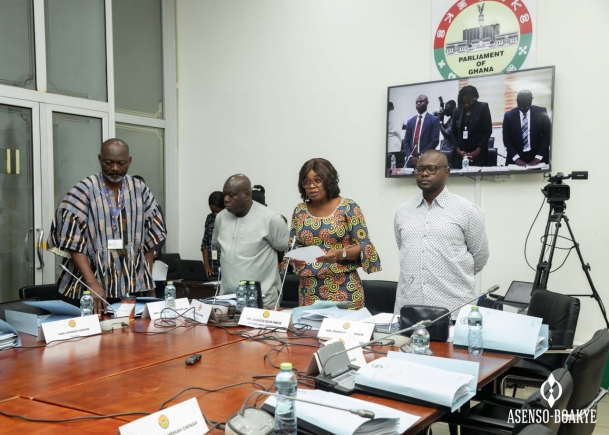
Parliament’s Local Government, Decentralisation and Religious Affairs Committee opened public hearings on October 5 into annual statements of MMDA audit committees. The two-day exercise concerns financial infractions identified in the 2025 Auditor-General’s Report involving the Greater Accra Regional Coordinating Council and assemblies in the region, principally in development projects. The committee’s ranking member urged scrutiny of whether earlier recommendations had been implemented and why weaknesses persisted. For counsel advising affected authorities, the hearings make records of corrective action and responses to previous audit findings particularly important, but do not themselves establish adjudicated liability.

The Ranking Member of the Parliamentary Committee on Local Government and Decentralisation, Francis Asenso-Boakye, has cautioned metropolitan, municipal and district assemblies (MMDAs) against allowing the same audit irregularities to recur year after year without meaningful corrective action.

He said the effectiveness of Ghana’s public audit system should ultimately be measured by whether audit recommendations were implemented, identified weaknesses addressed and systems strengthened.

“Audit findings should not become an annual ritual where the same weaknesses are identified year after year without adequate corrective action,” he said.

Mr Asenso-Boakye made the remarks at the opening of the Local Government, Decentralisation and Religious Affairs Committee’s public hearings on the annual statements of audit committees of MMDAs on Monday (Oct 5).

The committee, chaired by Queenster Pokuah Sawyerr, is probing financial infractions contained in the 2025 Auditor-General’s Report involving the Greater Accra Regional Coordinating Council and various MMDAs in the Greater Accra Region.

The two-day hearing, will probe infractions mostly arose from the implementation of various development projects by the MMDAs during the year under review.

Mr Asenso-Boakye said Parliament must pay particular attention not only to the irregularities identified in audit reports but also to the reasons the weaknesses persisted and whether recommendations from previous audits had been effectively implemented.

He said the committee’s responsibility went beyond identifying infractions, stressing the need to determine the underlying causes of recurring weaknesses and ensure that practical corrective measures were put in place to prevent them from recurring.

“The true value of an audit process lies in whether its recommendations lead to improved systems, stronger internal controls, better financial management and, ultimately, better outcomes for our people,” he stated.

Mr Asenso-Boakye, a former Minister of Roads and Highways, said where breaches involved the misuse of public funds or disregard for established procedures, appropriate accountability must follow.

He said audit findings should therefore not be treated merely as issues to be recorded in annual reports, but as opportunities to correct weaknesses and improve the management of public resources.

While calling for stringent corrective measures, the Bantama MP said Parliament should also push for reforms where challenges stemmed from institutional, capacity or systemic weaknesses.

He called for frank and constructive engagement between the committee and officials of the assemblies throughout the hearings to help identify the factors contributing to recurring irregularities and find sustainable solutions.

He said the ultimate objective should be to strengthen local governance systems and ensure that public resources were managed responsibly and used for their intended purposes.

“The ultimate objective should be to strengthen local governance systems and ensure that public resources are managed responsibly and used for their intended purposes,” he said.

Read at Graphic Online →